
Catalogue of Uncommon Curatorial Practices
Sensing Saintliness in the Diaspora: Making of a Sufi Heritage in Montreal
by Fawaz Abdul Salam
It was a late September evening in Montreal in 2025 when I had the opportunity to attend the Sufi gathering at the Montreal Sufi Centre in Mile-End, affiliated with the Naqshbandi-Haqqani Sufi Order. Unlike the regular meetings that take place on Thursday and Saturday evenings under the spiritual guidance and companionship of the community leader and Sufi master Shaykh Omar, the community members were anticipating the arrival of a guest, another Sufi master, Shaykh Abdul Haqq from Houston. As I entered the Sufi Center, also called a zawiya by community members, I found the space inside very warm and cozy, as the fall temperatures in Montreal had been dropping in preparation for winter.[1] The gathering space for sohba (spiritually rooted conversation) and dhikr(remembrance of God) had been tidied and fragranced with oudh (agarwood). I sat in one corner of the zawiya and conversed with community members as we awaited the guest’s arrival.
After a while, Shaykh Abdul Haqq arrived at the zawiya together with Shaykh Omar. As they entered, the community members stood up and welcomed them by singing Ṭala’a al-Badru ‘Alaynā, a song that was sung when the Prophet Muhammad entered the city of Medina following his emigration from Mecca with his companions. Once Shaykh Abdul Haqq had greeted everyone (some kissing his hand, others shaking it), he sat down among the community members. The evening call to prayer was then made by Sidi Anouar, a Moroccan singer and musician who has been closely affiliated with the community for several years. As both the welcoming song and the adhān (call to prayer) were performed in the Hijazi scale (a melodic mode originating in the Hijaz region of the Arabian Peninsula), they created an acoustic atmosphere that transported one to the time of the Prophet Muhammad.
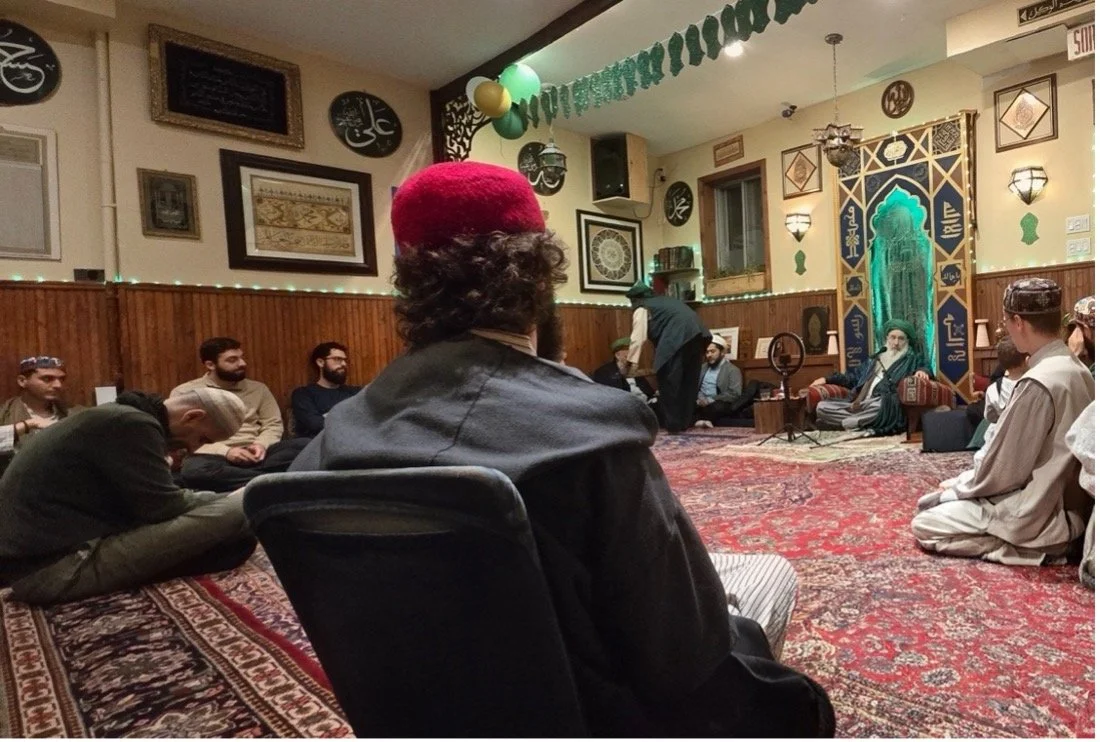
Figure 1: Community members await the sohba of Shaykh Abdul Haqq while Moroccan tea is being served.
After the evening prayer, the community members sat around Shaykh Abdul Haqq, awaiting his sohba and the collective practice of dhikr under his guidance, while some volunteers served Moroccan tea. During this brief pause, I considered a central question: how does the zawiya create saintly experience and spiritual intimacy? Is it merely the charisma of the saint that draws people to the zawiya? If so, why did Sufism play an integral role in the development of a rich and diverse artistic and material culture historically? Scanning the interior decorations of the zawiya, one encounters calligraphies bearing Quranic verses and veneration of the Prophet Muhammad, Naqshbandi prayer litanies and spiritual genealogies, woodwork of geometric patterns, Persian rugs, and other artistic objects. These materials raise a further question: how do sight, touch, smell, sound, and the feeling of inhabiting a saintly space and time interact? In other words, as recognized by the art historian Peyvand Firouzeh (2025), how do small places and the material culture of Sufis help us understand the active role they played in shaping their environments to create spaces of spiritual intimacy and sensory experience?
According to the famous 12th-century Sufi saint Ibn al-ʿArabī (1165-1240), the senses play an important role in the spiritual experience of saints and those who seek to attain spiritual elevation. According to him, “saints enjoy special sensory powers: they see, hear, smell, taste, and feel more, and better, than ordinary human beings” (Lange 2024, 438). He critiques the proponents of rational theology and speculative philosophy of his time for advocating these approaches as the means of gaining knowledge of God. In his view, salvific knowledge of God is gained through experiential mystical states, which are achieved most fully by the Sufi saints (Lange 2024). If one looks at the development of Sufism in early Islamic history, around the mid-9th century the practice of asceticism and mystical contemplation among Muslims emerged both as a search for experiential knowledge of God and as a response to the “corrupt world” mired in political schism, theological debates, and the luxurious lives of many Muslim elites (Knysh 2010). Often resembling Christian monastic practitioners of the Near East, these early Sufis opted to wear a woollen robe, wool being known as Sūf in Arabic, hence Ṣūfiyya or Sufis as the people of wool. The adoption of the rough woollen garment served two purposes: first, it was worn in deliberate contrast to the expensive and comfortable cotton and silk garments used by the Muslim elites; and second, it served as a constant reminder to oneself to remain conscious of the human ego and its desire for ease and comfort. This early Muslim Sufis were primarily engaged in individual spiritual retreats (khalwa) in solitude, disciplining the body through extensive fasting, prayers, and supplications. The search for salvific knowledge of God was, therefore, largely an austere process (Kara 2007).
Given this early austere development of Sufism, it would come as a surprise to find that Sufis and their spiritual discourse went on to influentially shape the Islamic artistic, poetic, musical, literary, and aesthetic traditions from the 11th and 12th centuries onward. With the institutionalization of Sufism as an integral part of the Islamic tradition, the emergence of Sufi lodges as spaces for the production and transmission of spiritual discourses and practices, and the eventual royal patronage of Sufism by political and wealthy elites (Kara 2007; Papas 2020), material culture became inseparable from the preservation and transmission of Sufi heritage. The growth of diverse networks of Sufi orders and their lodges, the means and mediums through which mystical knowledge and experiences were sought varied across Muslim geographies, from the Balkans to Bengal and beyond (Green 2012b). Notably, the emergence of shrines built around the burials of Sufi saints further elevated the sacred nature of a Sufi space, giving rise to shrine complexes (maqam: a blessed place) and commemorative rituals (famously known as urus; the day of the union of the saint with God). The production and circulation of hagiographies and epigraphs also played an important role in transmitting accounts of saintly miracles and the sacredness of Sufi shrines. Sufi spaces, as they adapted to local cultural contexts, incorporated a variety of spiritual discourses and practices, including sensory media, to appeal to the local audience. Musical and dance performances, the distribution of food, healing practices, and perfumery all became integral to Sufi shrine culture in the Muslim world (Ernst and Bruce 2002; Bashir 2011; Green 2012a; Firouzeh 2025).
Shrine culture and Sufism more broadly came under attack during the revivalist and reformist currents that emerged in the Muslim world from the early 19th century onward. As the encounter of Muslim regions with colonial modernity fundamentally shifted the way the Islamic tradition was interpreted and practiced, both historically transmitted scholarly and saintly authorities were questioned. The reformist currents urged a return to the foundational sources of the tradition, i.e., the Quran and the Sunnah (the normative tradition of Prophet Muhammad), emphasizing a direct relationship with the divine, denying the role of saintly intermediaries, and rejecting the role of Sufi shrines and lodges in the practice and experience of Islam as innovations. More recent scholarship in the study of Islam has critiqued a narrow reading of Islamic reformism as a product resulting solely from Muslim intellectuals’ encounter with colonial modernity (Haj 2009). However, it is undeniable that the reformist discourse had an impact on local practices and experiences of Islam. More specifically, Sufism, as a spiritual tradition that integrated embodied experience attuned to varieties of human sensorium, was largely marginalized by a textually centred discourse. Hence, except for a few studies in anthropology of Islam, art history and architectural history for the last two decades, study of Islam and Muslims were largely attentive to the interpretations and debates around the transmission of textual traditions.
The “sensual turn” in the social sciences and humanities has critiqued the “hegemony of vision” (Howes 2003) and textual centrism, it has drawn increasing attention to the social production of sensory experience in different cultures. Christian Lange notes that, despite important interventions in the study of the senses in the West, investigations into Muslim sensoriums have been largely neglected. Volume 17 (2022) of Senses and Society journal, and Islamic Sensory History, edited by Christian Lange and Adam Bursi, are important recent contributions in the historical study of Muslim sensoriums and sensory discourses, and highlight the need to explore the hierarchies of the senses developed historically in the Muslim world and their transformation under modernity. This probe addresses that gap by offering preliminary insights into how the senses mediate saintliness, spiritual knowledge, and experience for Muslims, especially when they are away from Muslim-majority religious and cultural environments.
The Montreal Sufi Centre provides a case study in both continuity and rupture in the transmission of an orthodox Sufi tradition, as well as in its sensory culture, within a diasporic context. The Naqshbandi-Haqqanis, who themselves draw their affiliation to the Naqshbandi-Mujaddidi Sufi movement of South Asia that emerged as a reformist and revivalist movement within Indian Sufi culture. In the 18th century, the founder of the movement, Imam Ahmad Sirhindi (1564-1624), vehemently critiqued the excessive religious syncretism accommodated into Sufi rituals and shrine spaces, which had been utilized for the positive integration of Islam in the subcontinent. While the Mujaddidi tradition became an orthodox revivalist Sufi movement across the subcontinent, Central Asia, and the Ottoman lands, promoting sharia-compatible Sufi and scholarly discourses, the Naqshbandi-Haqqanis’ influential growth in the West since the 1970s has led them to adopt a more pluralistic Sufi discourse, focused on creating a space of belonging for Muslims and non-Muslims alike.
The community identifies its space as a “spiritual oasis” in the cosmopolitan neighbourhood of Mile End, inviting not only Muslims in the city but also new Muslim converts as well as non-Muslims. Here, the careful curation of the interior design of the Sufi Centre and the choreography of the weekly activities involve appealing to the visual, olfactory, aural, and tactile senses of participants. While the primary objective of the Centre is to encourage participation in the dhikr under the guidance of a spiritual master, the sensory media enhance the experience of being part of the dhikr sessions. In terms of its interior design, the Centre closely resembles an Ottoman Sufi lodge. Given that the Haqqani offshoot was founded by Shaykh Nazim Al-Haqqani (1922-2014), of Turkish origin, and that the first Sufi lodge he and his followers established was in Turkish Cyprus, the Ottoman influences are evident. In addition, as Shaykh Nazim grew up in an environment where the activities of Sufi orders and the running of lodges were abolished following the establishment of the Turkish secular republic, keeping alive the memory of Ottoman Sufi heritage is also intentional. Representing this Ottoman heritage is not specific to the Montreal Centre but can also be found in other zawiyas of the community, as observed by Simon Stjernholm in his sensory study of the Haqqani zawiyas in London, UK, and Lefke, Turkish Cyprus (Simon 2025).
A few weeks after the visit of Shaykh Abdul Haqq, I was invited to drink coffee at the house of a community member, along with some other guests who frequent the zawiya. I had the opportunity to ask about my curiosity regarding what makes a Sufi lodge a saintly space, or how one feels the experience of saintliness. One of them insisted that the charisma and blessing of the saint were the only factor that brings one to the zawiya, another member suggested that the spiritual environment and atmosphere of the space play an important role in the experience of saintliness. He then recollected his time at the zawiya in Cyprus, and shared how, for instance, Shaykh Nazim never encouraged the use of the plain lined carpets, without any decorative patterns commonly used in mosques, and instead encouraged the use of Persian rugs with vegetal and floral motifs. In addition, he shared how Shaykh Nazim was unhappy with the rebuilding of the old wooden mosque complex next to the zawiya with concrete bricks when it underwent renovation. Though, I haven’t had a chance to visit the zawiya in Cyprus, the photos available on the internet shows that the zawiya in Montreal resembles very much like there. As Shaykh Nazim passed away in 2014, his memory is preserved not only through hagiographies and other textual and oral mediums, but also through maintaining a space that closely resembles to one in Cyprus where he once lived.
While the Sufi Centre is not a purpose-built space, after its purchase in 2004 it was gradually turned into a space reflecting a medieval Sufi lodge. As the walls were made of brick and concrete, after the purchase the community added a layer of wooden interior and geometric patterns. The community members contributed in various capacities to curating the space, such as gifting calligraphic works and Persian rugs, drawing colorful geometric patterns, and writing the spiritual genealogy of the Naqshbandi master on the walls, highlighting the collective effort in creating an affective space of belonging.
The lighting is also arranged according to the various needs during theweekly gathering, as the lights are dimmed during the collective dhikr, making only the Sufi master who is leading it visible.[2] Dhikr practices are often accompanied by daf beats (frame drum), and during the recitation of qasida (poetry in praise of the Prophet Muhammad and saints), Middle Eastern instruments such as the oud and qanun are also occasionally played. The musical atmosphere of the zawiya is also captured in short documentaries and videos produced by a community member and a Montreal-based filmmaker, incorporating musical sessions recorded alongside archival video clips showing camel caravans and desert social life, invoking a nostalgia for times gone by.[3]
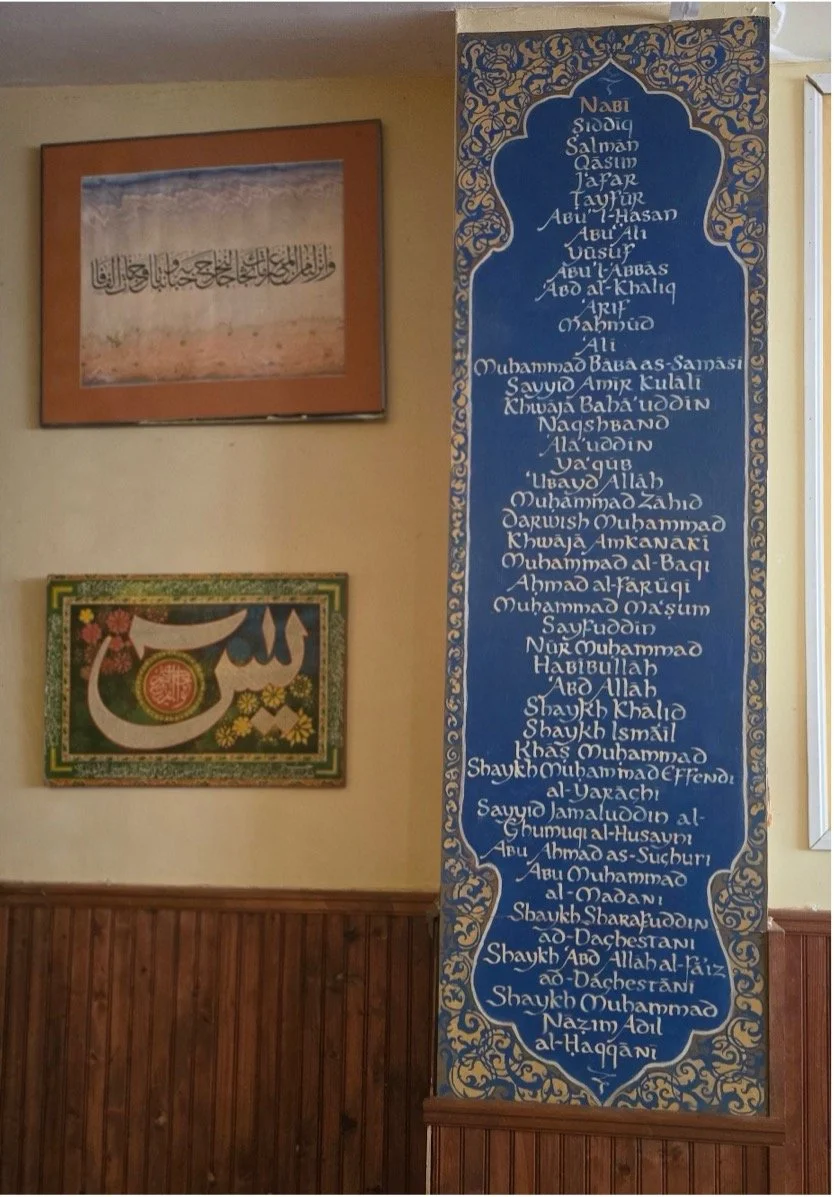
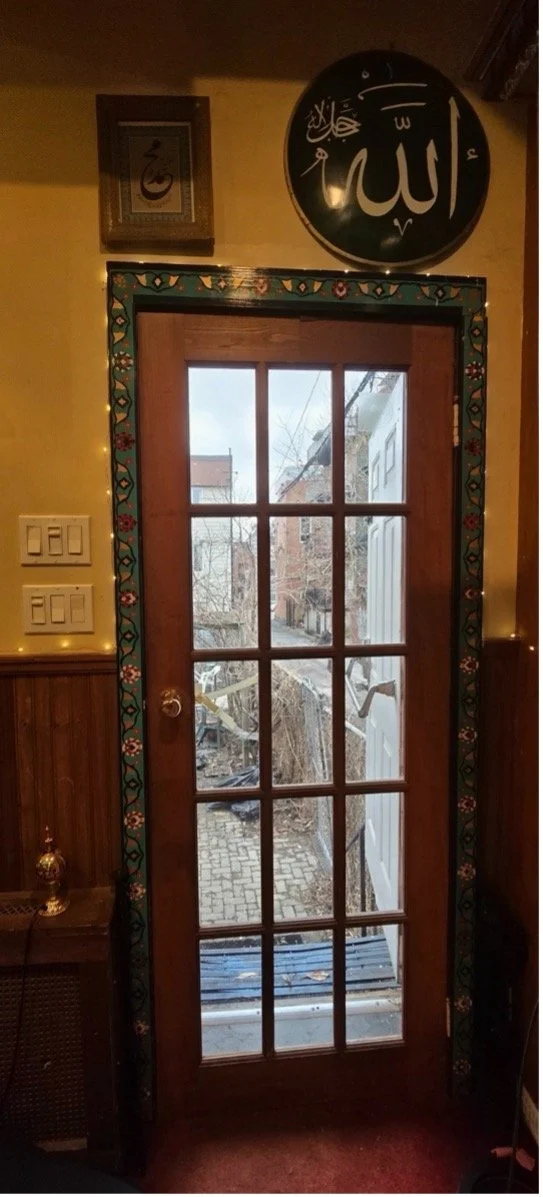
Figure 2 and 3: Naqshbandi spiritual genealogy from Prophet Muhammad to Shaykh Nazim, along with calligraphic and other artworks represented at the Sufi Centre.
Before the end of a weekly meeting, dinner is served for those who have gathered. Even before dinner is served, one can recognize the smell of it being prepared in the basement kitchen of the zawiya. As most of the community members are of North African or West African background, the food usually prepared is from those regions. Three or four participants share the food from a large plate. As dinner time provides a space for conversation among the participants, one could occasionally hear the food being praised, and how, even if there is little to share, a baraka (blessing) imbues the food because it was prepared in a saintly place and eaten collectively.
From the interior design to the sound, light, smell, and taste one experiences and feels at the zawiya, one is invited to think about how the senses play an important role in mediating the saintliness of a Sufi space. While the ultimate goal of Sufi discourses and practices is understood to be the transcendence of the materiality of the physical world, desires and egos, through spiritual retreat and the purification of the self, in order to gain haqiqa (the real truth of God) and marifa (the real experience of mystical knowledge), the embodied spiritual journey is initiated in an environment where different senses are attuned to the saintly experience. This experience becomes more prominent and spiritually enhancing in a Muslim-minority context, where the public sphere is largely “secular” and less accommodating of religious or spiritually informed environments. Hence, the representation and curation of Sufi material culture in the zawiya also prompts one to think about how a living heritage discourse, as well as alternative museum practices, is being introduced into the province by minority religious and ethnic communities — a topic to be explored in the second part of this probe.
I was commissioned to write this probe for the “Sensitive Material” project (funded by a grant from the Social Sciences and Humanities Research Council of Canada) during my tenure as a postdoctoral fellow attached to the Department of Religions and Cultures (under the direction of Professor Sowparnika Balaswaminathan) and the Centre for Sensory Studies, Concordia University, Montreal. My postdoctoral position was funded by the Fonds de Recherche du Québec - Société et Culture.
End Notes:
[1] While the place is known officially as the Montreal Sufi Centre, community members call it a zawiya, a term used in Arabic for Sufi lodges since the medieval period in North African regions. Sufi lodges were also called tekke, khanqah, and dargah.
[2] For more on the importance of the visibility of the face of the Sufi master/saint during dhikr, as well as the reproduction of photos of Shaykh Nazim in Haqqani Sufi lodges, see Naïm Jeanbart, “Performances of portraits: Ubiquity, minimality, and proximity with pictures of a late Sufi Sheikh.”
[3] See for example, https://www.youtube.com/watch?v=jMImF-DHMvg&list=RDjMImF-DHMvg&start_radio=1.
References:
Bashir, Shahzad. Sufi Bodies: Religion and Society in Medieval Islam. New York: Columbia University Press, 2011.
Ernst, Carl W., and Bruce B. Lawrence. Sufi Martyrs of Love: The Chishti Order in South Asia and Beyond. New York: Palgrave Macmillan, 2002.
Firouzeh, Peyvand. Intimacies of Global Sufism: Ne'matullahi Shrines and Material Culture Between Iran and India. Bloomington: Indiana University Press, 2025.
Green, Nile. Making Space: Sufis and Settlers in Early Modern India. New Delhi: Oxford University Press, 2012a.
Green, Nile. Sufism: A Global History. Wiley Blackwell Brief Histories of Religion. Chichester, West Sussex; Malden, MA: Wiley-Blackwell, 2012b.
Haj, Samira. Reconfiguring Islamic Tradition: Reform, Rationality, and Modernity. Stanford, CA: Stanford University Press, 2009.
Howes, David. Sensual Relations: Engaging the Senses in Culture and Social Theory. Ann Arbor: University of Michigan Press, 2003.
Jeanbart, Naim. “Performances of portraits: Ubiquity, minimality, and proximity with pictures of a late Sufi Sheikh”, Civilisations, 72 (2023), 117-133.
Karamustafa, Ahmet T. Sufism: The Formative Period. Edinburgh: Edinburgh University Press, 2007.
Knysh, Alexander. “Sufism.” In The New Cambridge History of Islam, Vol. 4, edited by Robert Irwin, 60–64. Cambridge: Cambridge University Press, 2010.
Lange, Christian. “Introduction: The Sensory History of the Islamic World.” The Senses and Society 17, no. 1 (2022): 1–7.
Lange, Christian. “Ibn al-ʿArabī (d. 638/1240) on the Masters of Sensation.” In Islamic Sensory History, Vol. 2: 600–1500, edited by Christian Lange and Adam Bursi, 437–447. Leiden: Brill, 2024.
Lange, Christian, and Adam Bursi, eds. Islamic Sensory History, Volume 2: 600–1500. Leiden; Boston: Brill, 2024.
Papas, Alexandre. “Introduction: What Is a Ṣūfī Institution? A Dichotomy in Ṣūfī Studies.” In Sufi Institutions, edited by Alexandre Papas, 1–24. Leiden-Boston: Brill, 2020.
Stjernholm, Simon. Sensing Islam: Engaging and Contesting the Senses in Muslim Religiosity. Bloomsbury Studies in Material Religion. London: Bloomsbury Academic, 2025.