
Catalogue of Uncommon Curatorial Practices
Sensing the surroundings of Tiohtià:ke (Montréal):
A review of an exhibition by Hannah Claus
by David Howes
tsi iotnekahtentiónhatie (Tiohtià:ke) – [where the waters flow] (Tiohtià:ke) – is the title of an exhibition featuring a series of works by Hannah Claus. The show ran at the Leonard & Bina Ellen Art Gallery in the J.W. McConnell (LB) Building at Concordia University from 19 November 2025 to 7 February 2026. Claus, a Kanien'kehá:ka (Mohawk) | English member of Kenhtè:ke (Tyendinaga Mohawks of the Bay of Quinte), is currently an associate professor in the Department of Studio Arts and the Co-Director of the Indigenous Futures Research Centre. She is the recipient of numerous awards, including an Eiteljorg Fellowship (2019) and the Prix Giverny (2020). In 2025, she was inducted into the Royal Society of Canada.
I was present at Claus’ artist’s talk on December 4th, took my Art, Aesthetics and Anthropology class to visit the exhibition one January afternoon, and also attended a special event called ‘Performance for Hannah’ by Tahltan First Nation performance artist Peter Morin on the evening of January 22nd.
Unlike a conventional exhibition, with artworks affixed to the walls or sculptures mounted atop pedestals, this exhibition was off the wall, and dynamic rather than static. It constituted a ‘performative sensory environment’ (Howes and Salter 2019), with an emphasis on embodied perception rather than ‘disinterested contemplation’ as per Kant’s definition of the aesthetic attitude, with the latter’s stress on passing judgment as opposed to experiencing art, or letting it envelope and permeate one’s being (Howes 2022:145-46; Classen 2017). Each piece was a wonder to behold and meant to trigger an awareness that we become what we behold.
The exhibition opens with Kaniatarowanen – othorè:ke nonkwá:ti, or watersong (2025) This installation consists of hundreds of threads – festooned with acetate disks, suspended from an undulating grid (701 x 365 cm) on the ceiling – that hang down to the floor (Figure 1). This arrangement references the Kanien’kehá:ka cosmovision, which places the skyworld above, the surface world in-between, and the underworld below and suggests how all three worlds are connected or inter-related: that is, the threads give material expression to the connections, render them sensible.
The air currents in the gallery (resulting from the visitors moving about) make the curtain of threads sway ever so gently so that the discs shimmer and cast refractions (as well as shadows) that swirl and dance on the surrounding walls. It was difficult to know where to look, where to focus, since one’s gaze was directed upwards and downwards along the threads – and all around, following the prismatic reflections given off by the discs.
The discs (each 7 cm in diameter) had been imprinted with photographic images taken from sites along the north shore of the island, and the pattern in which the threads were hung echoed the contours of the shoreline of Kaniatarowànen(Saint Lawrence River).
The discs on the threads also have a pattern, like the notes on a staff of music. This arrangement was actually keyed to the melody of a song that Claus had commissioned beforehand, composed by Kahnawakerò:non singer Ionhiarò:roks McComber, acknowledging and thanking the river. Claus used the recording of McComber singing to create a digital representation of the soundwaves of the singer’s voice, whence the positioning of the discs. The refrains of the song drifted into the gallery space from an adjacent room, filling in the air, and enhancing the sense of immersion.
Unlike the landscape painting of the Western art tradition that gave rise to the idea of ‘the picturesque’ (Broglio 2008), watersong is extra-visual, hence more in the nature of a sensescape. In effect, this work transposed a song into a sight, sounds into a shape. It is a cross-sensory or intersensory arrangement (Howes 2022), which (again) gives sensible expression to a connection (i.e., song-sight). watersong, then, is both cosmic in scope and intensely local – attentive to the smallest detail of the sensescape of the island – that is, the intricate imagery of rocks and plants, etc., on the discs (Figure 5b), details we often overlook.
skystrip (2006) consists of a canvas depicting a strip of sky with fleecy clouds (Figure 2a and 2b). It is based on some photographs Claus took of the upper world from a path atop Mont Royal, facing north. The canvas does not lie flat against the wall. It is pulled out from the wall by a series of criss-crossing threads (some 31 in all) tied to rocks arranged on the floor (the whole piece measures 165 x 183 x 609 cm). Here again we have an example of art off the wall, and of space that is not empty, but rather imbricated or transected by diverse sightlines, as connoted by the threads.
The series flatrocks (2024), which consists of four acrylic panels (137 x 91 cm each), also enlivens one’s gaze by directing one’s attention to minutiae – in this case the colors and textures of submerged rocks from along the shoreline of Kaniatarowànen (Figure 3). Claus digitized and transmuted the original photographs so that they form a kaleidoscopic pattern. The shininess of the acrylic surface of the panels augments the gleaming surface of the water covering the rocks, and so liquefies one’s gaze. Rather than ‘through a glass darkly,’ one perceives the rocks though water luminescently.
The exhibition also consists of two installations involving video projections. iakoròn:iens’ [the sky falls around her] (2020) is a video looking up at a white-grey sky through a canopy of leaves (Figure 4). Pieces of the sky break off and float down, like snowflakes, leaving patches of black sky in their place. It was conceived during the COVID-19 pandemic, when everything about our existence seemed to be falling apart, and our relationships fragmented.
reflection on river rock [Blue Nordic] (2003) consists of a circle (150 cm in diameter) filled in with stones. The overhead projector casts an image of a blue and white dish brimming with water onto the stone circle, with its surface repeatedly interrupted by drips of water, as if from a leaky faucet. This piece was actually inspired by the leaky faucet in Claus’ first apartment in Montréal. It bears noting that on the island of Montréal, most streams have been rerouted underground via sewers (Hetherington 2025), and potable water is distributed to households through a complex system of pipes. Thus, the waterworks of Montréal have been channelled and commodified. The drips in reflection on river rock [Blue Nordic]are a reminder that water can never be completely contained, or domesticated.
The finale of the show is located in the outermost room of the Gallery (Figure 5a and 5b). It is called dish (2025), and consists of hundreds of discs with images of native edible and medicinal plants arranged on threads suspended from a grid on the ceiling to form a giant, 3D bowl (305 x 305 x 305 cm). This piece references the Dish with One Spoon wampum.
Historically, or since time immemorial, wampum belts were exchanged to commemorate the treaties that Indigenous nations (Haudenosaunee, Anishinaabeg, etc.) negotiated with each other to put an end to violent conflict, sometimes only temporarily, and at other times ensuring an enduring peace. Dish with One Spoon, then, gives expression to an Indigenous legal principle: ‘The “dish” represents the land that is to be shared peacefully and the “spoon” represents the individuals living on and using the resources of the land in a spirit of mutual co-operation’ and sustainability – taking only what one needs, or ‘with one spoon’ (Glover 2020). It entails sharing hunting territories while also respecting each nation’s sovereignty.
It bears noting that Claus had earlier created another such installation called our minds are one (2014) which is in the collection of the National Gallery of Canada. This companion piece takes the form of a dome rather than a bowl. One is left to imagine how the two works could be united into a single whole that encompasses the entirety of the cosmos.
In the beautifully written, trilingual (Kanien’kéha | English |French) essay that accompanies the exhibition, curator Nicole Burisch evokes the over-arching message of the show as follows:
‘The artworks in tsi iotnekahtentiónhatie each offer a specific way of relating to the lands and waters that are part of Tiohtià:ke, grounded in Kanien’kehá:ka worldview and ways of knowing and being in relation with this place. From within the context of a busy urban space, Claus reminds us that there is time to pay attention to singular details, to remember the histories of this island, and to centre embodied relationships and responsibilities to the natural world.’ (Burisch 2025: 14)
At her artist’s talk on the evening of December 4th, Claus opened with a version of the Ohenton Karihwatehkwen [Words Before all Else] protocol, also known as the Thanksgiving Address:
All the People
Our Mother the Earth
All the waters
All that lives in the waters
All the roots
All the grass and flowers
All the insects
All the medicines
All the fruits
The sustenance foods
All the trees and bushes
All the animals
All the birds
The Four Winds
Our Grandfathers the Thunderers
Our Elder brother the Sun
Our Grandmother the Moon
The stars
The Great natural power
Claus distributed a script of the address, and each member of the audience was invited to recite one of its lines, followed by the phrase ‘And now our minds are one.’ This protocol heightened the participatory character of the exhibition.
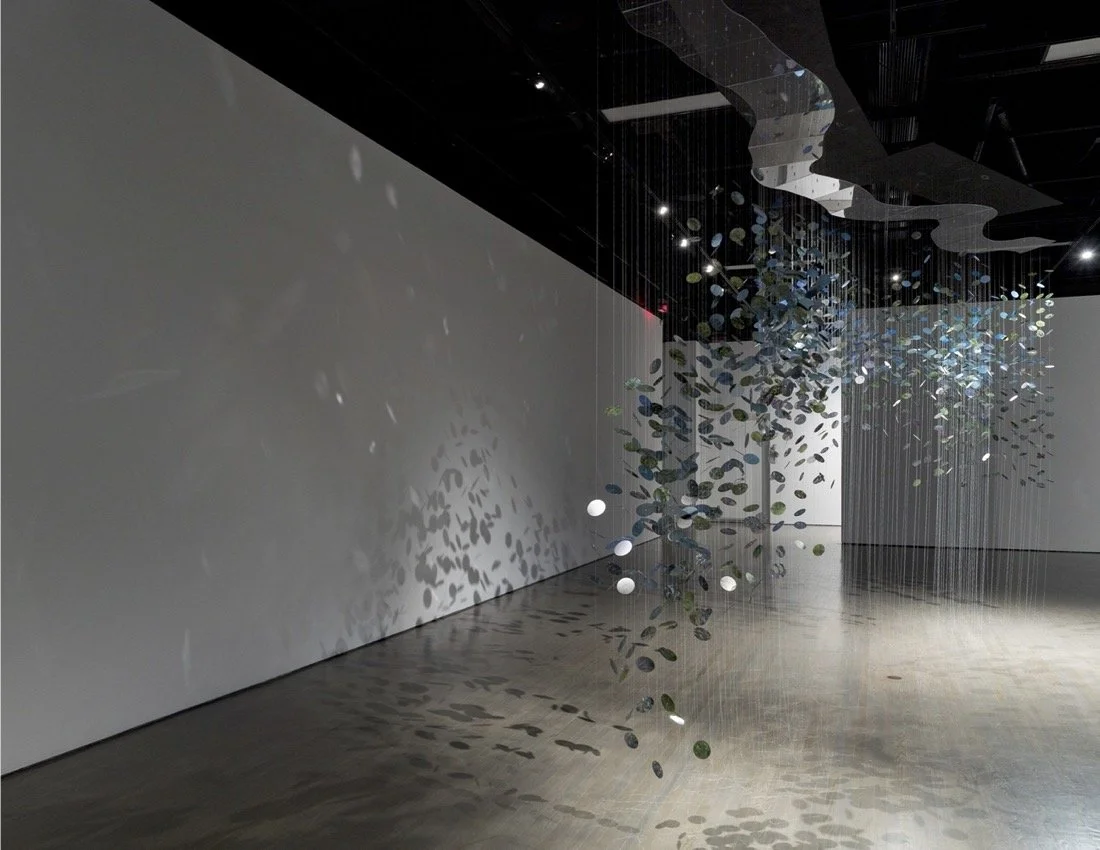
Figure 1: watersong [Kaniatarowanen – othorè:ke nonkwá:ti], 2025. Acrylic, thread, glass beads, digital prints on Jetview film, PVA glue 701 × 365 cm. Composer of the song: Ionhiarò:roks McComber. Photo credit: Jean-Michael Seminaro. Courtesy of the Leonard & Bina Ellen Art Gallery.
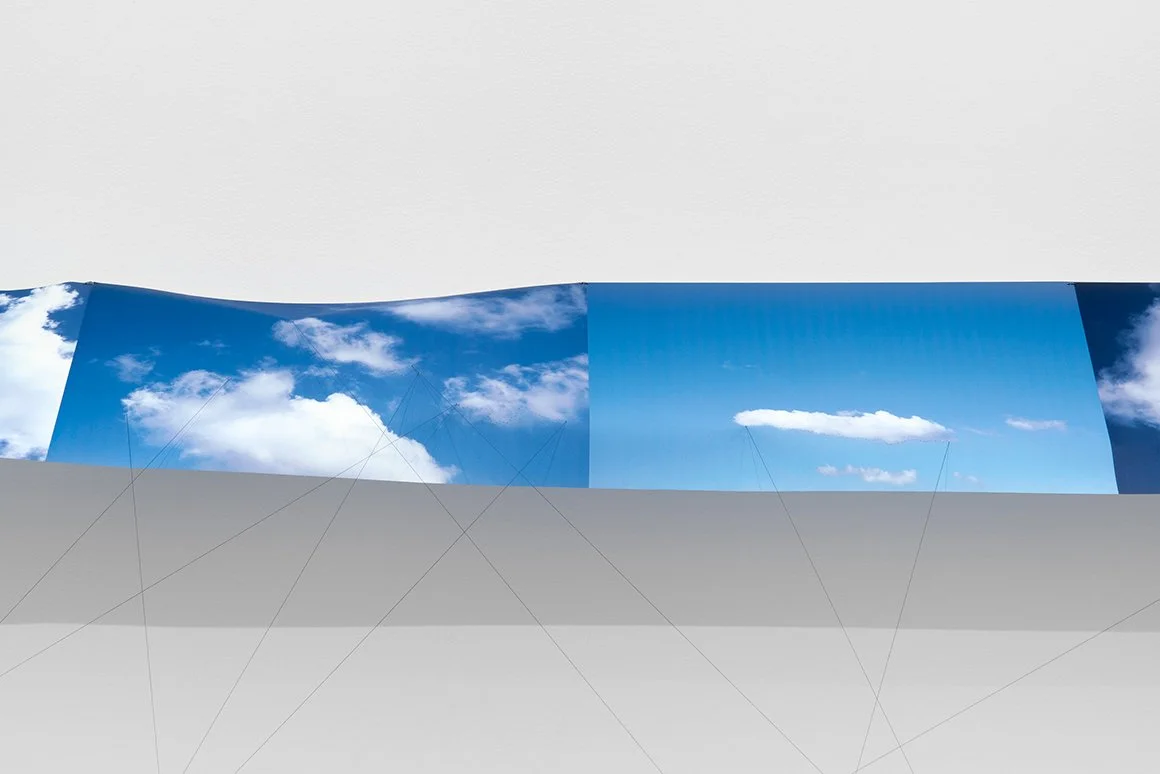
Figure 2b (detail): skystrip, 2006. Digital print on polypropylene banner, thread, river rocks 165 × 183 × 609 cm. Photo credit: Jean-Michael Seminaro. Courtesy of the Leonard & Bina Ellen Art Gallery
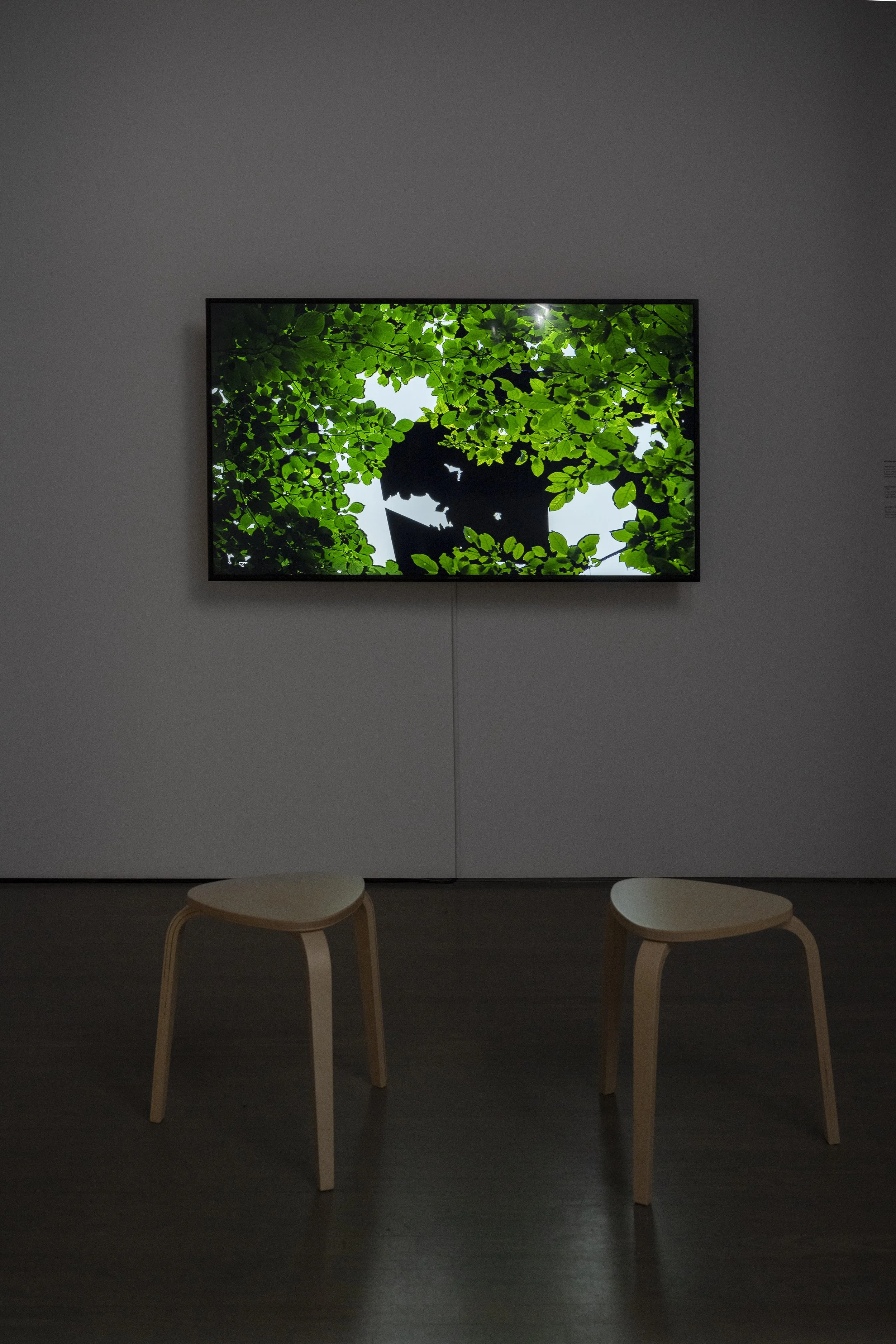
Figure 4: iakoròn:ien’s [the sky falls around her], 2020. Single-channel video, 5 min. Video technician: Raohserahà:wi Hemlock. Photo credit: Paul Litherland. Courtesy of the Leonard & Bina Ellen Art Gallery.
Figure 6: Peter Morin addressing watersong by Hannah Claus. Photo credit: Pierina Corzo-Valero–Morin. Courtesy of the Leonard & Bina Ellen Art Gallery
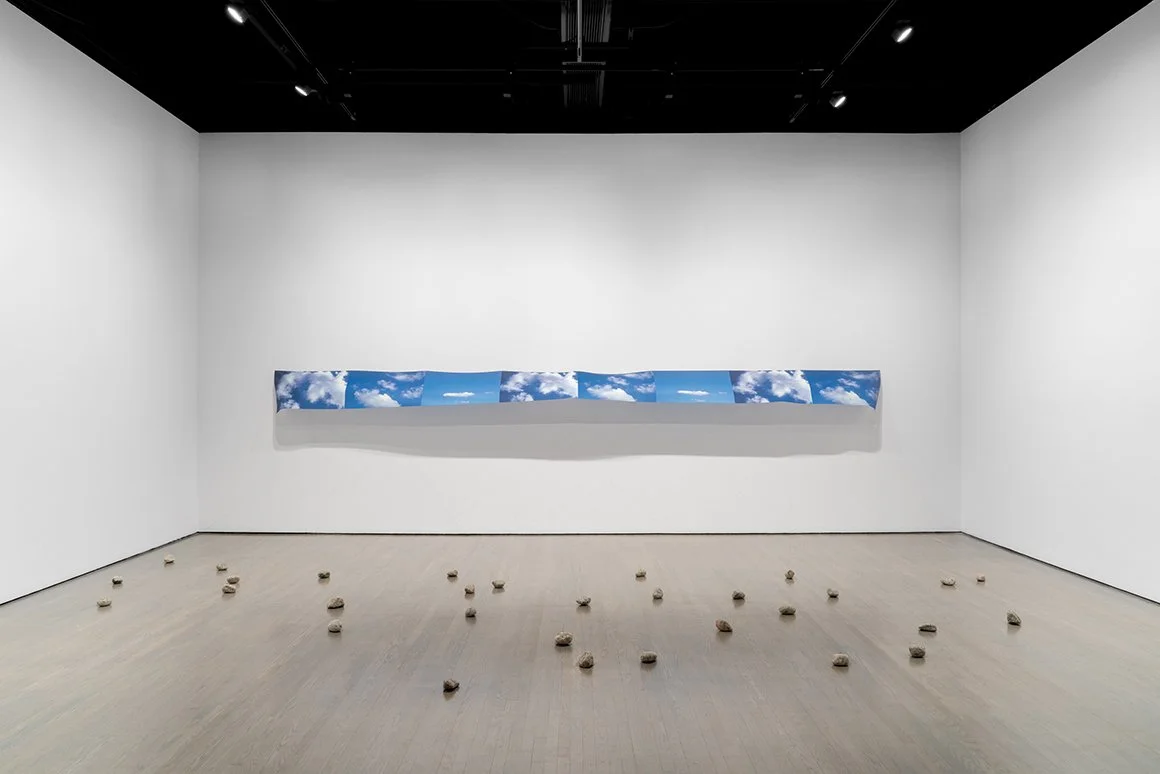
Figure 2a: skystrip, 2006. Digital print on polypropylene banner, thread, river rocks 165 × 183 × 609 cm. Photo credit: Jean-Michael Seminaro. Courtesy of the Leonard & Bina Ellen Art Gallery
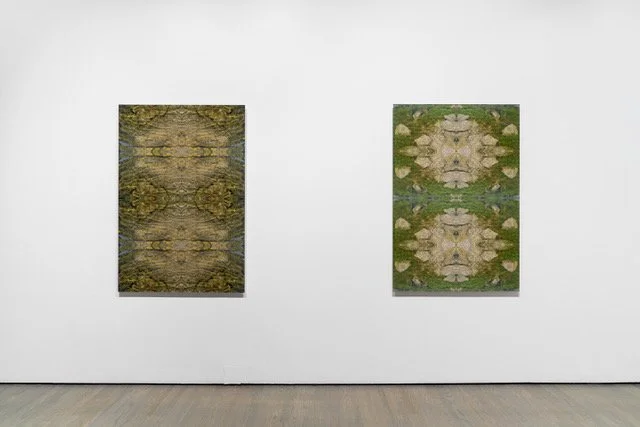
Figure 3: flatrocks, 2024. Digital print facemounted on acrylic sheet 137 × 91.5 cm. Photo credit: Jean-Michael Seminaro. Courtesy of the Leonard & Bina Ellen Art Gallery.
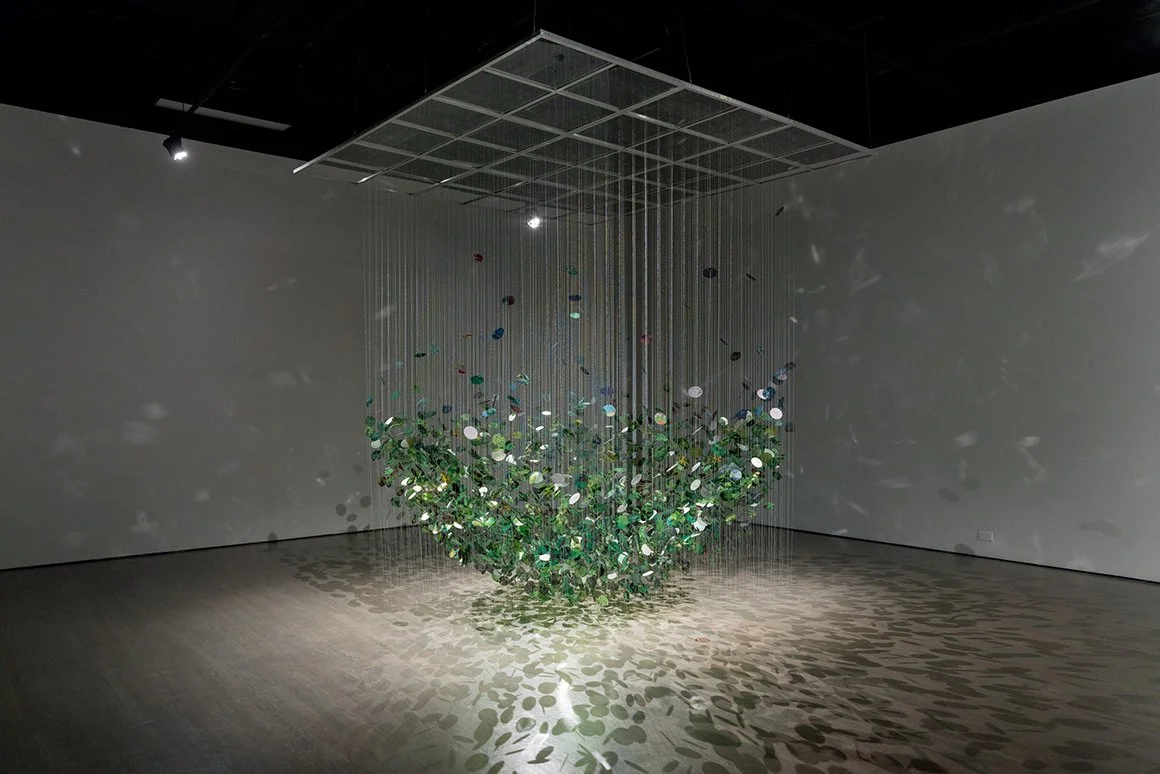
Figure 5a: dish, 2025. Acrylic, aluminium, glass beads, thread, digital prints on Jetview film, PVA glue 305 × 305 × 305 cm. Photo credit: Jean-Michael Seminaro. Courtesy of the Leonard & Bina Ellen Art Gallery.
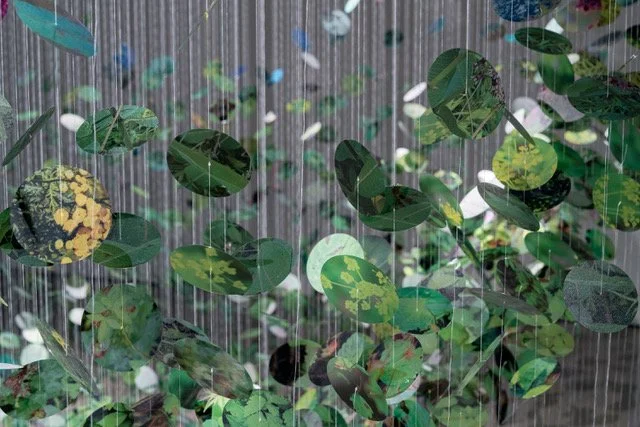
Figure 5b (detail): dish, 2025. Acrylic, aluminium, glass beads, thread, digital prints on Jetview film, PVA glue 305 × 305 × 305 cm. Photo credit: Jean-Michael Seminaro. Courtesy of the Leonard & Bina Ellen Art Gallery.
The engagement of the minds and senses of the audience was heightened yet again by Peter Morin’s intervention on January 22nd entitled ‘Performance for Hannah.’ On this occasion, Morin begins by laying out his paraphernalia on the other side of the thread curtain from where the audience is positioned. His kit consists of a beaver pelt, a deer hide with a cut-out of the words ‘love song,’ a necklace, a drum and the materials for a smudge.
Morin’s intervention commences with the lighting of medicine in an abalone bowl which has the effect of filling in the air of the gallery with the smouldering scent of sage. The smell of the smoke mingles with the glints of the dancing discs and the gentle intonations of McComber’s voice off in the distance.
Morin does not comment on the artworks or ‘interpret’ them. Instead, he performs them. The kinetics of his performance are fascinating to behold. For example, when he moves, he does not walk upright, but rather slightly stooped, stepping gingerly on the tips of his toes rather than the balls of his stockinged feet. He is wearing camouflage clothing (Figure 6). This attire references two things. One is the camouflage garb of the Kanien’kehá:ka Warrior Society, protectors of the Earth, who confronted the Canadian Army during the Siege of Kanehsatà:ke, or what the Canadian media branded as the Oka Crisis, 1990.
The Oka Crisis was precipitated by an attempted land grab (de Bruin 2013). The Town of Oka (without consultation) proposed to expand a nine-hole golf course into an 18-hole course and build a townhouse complex on the disputed traditional territory of the neighbouring Kanien'kehá:ka community of Kanehsatà:ke, including an ancient burial ground. The protest by members of the Kanehsatà:ke community escalated, and the Warrior Society along with other members of the Kanien'kehá:ka community of Kanawàke subsequently barricaded the Mercier Bridge, in sympathy with the former’s demands, and to the consternation of the residents of Châteauguay, whose main access route to Montréal was thereby cut off. This led to the Sûreté du Québec (SQ), the RCMP and eventually the Canadian Armed Forces being called in to quell the rebellion. The armed stand-off lasted 78 days, and reports of it made headlines both nationally and internationally.
During the multiple mêlées, a SQ police officer was killed by a gunshot (it was never determined who fired the shot), two Mohawk men died from heart attacks brought on by their evacuation convoy being stoned by an angry mob of Châtauguay citizens, and a 14-year old Mohawk girl, Waneek Horn-Miller was stabbed in the chest with a bayonet, but survived. In the end, the golf course expansion project was cancelled and the federal government purchased the disputed territory (known as ‘the Pines’) and additional plots to prevent further development. This land is ‘reserved’ for the Kanien'kehá:ka of Kanehsatà:ke, but there has yet to be an actual transfer
The Oka Crisis was a moment of reckoning. Québécois.es/Quebeckers’ innocence was lost – or not innocence so much as ignorance and indifference to ‘native affairs.’ The Kanehsatà:ke Resistance did mark a difference. For example, it led to the creation of the Royal Commission on Aboriginal Peoples (1996) and also sowed the seeds for the pan-Canadian Indigenous Idle No More movement and other acts of protest.
Morin’s camouflage clothing references his identification with the land and the more-than-human, his becoming ground. By wearing it, he smuggles earth into the pristine confines of the Ellen Art Gallery, a classic example of ‘White Cube’ architecture. The camouflage clothing ‘brings the outside in,’ as he put it.
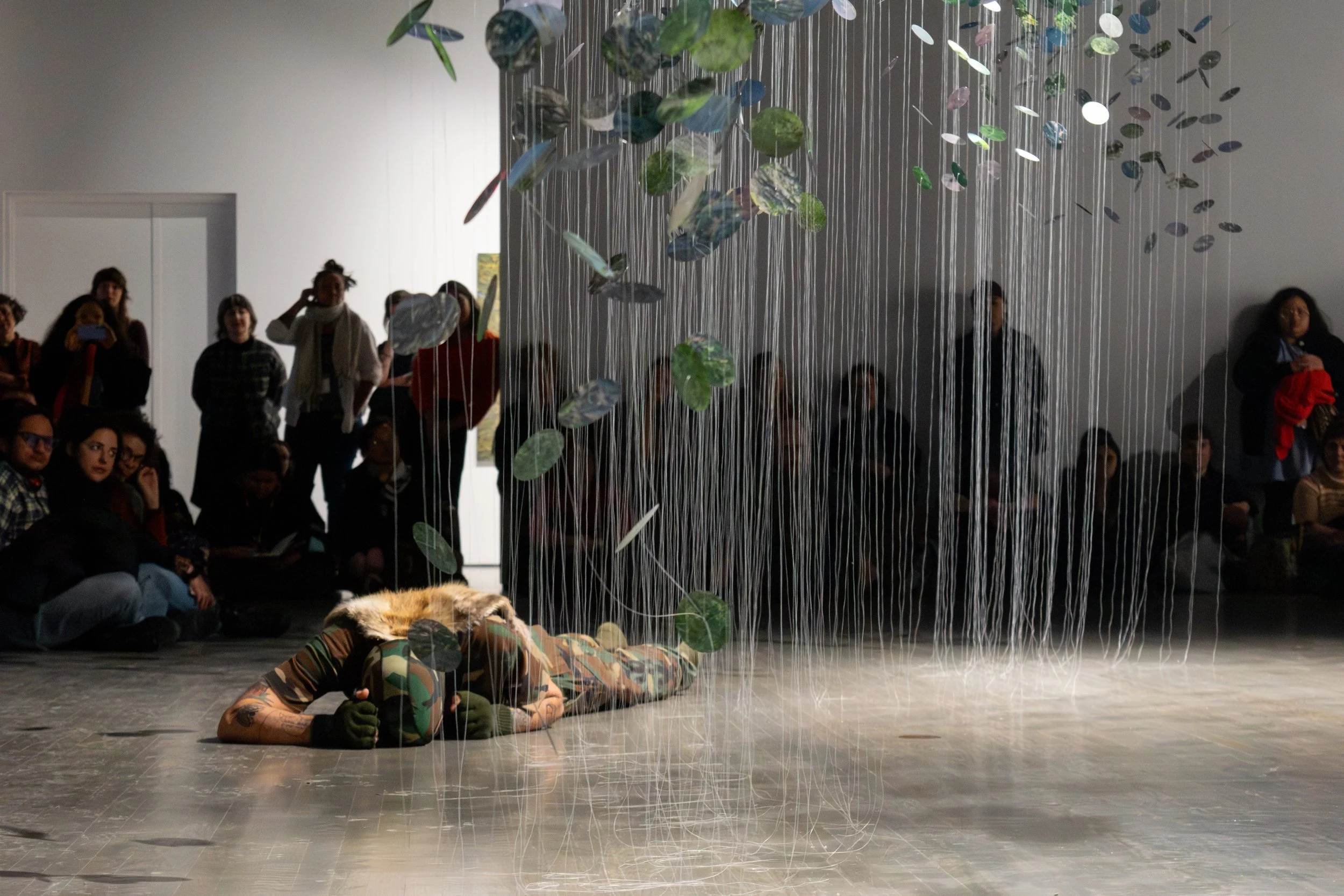
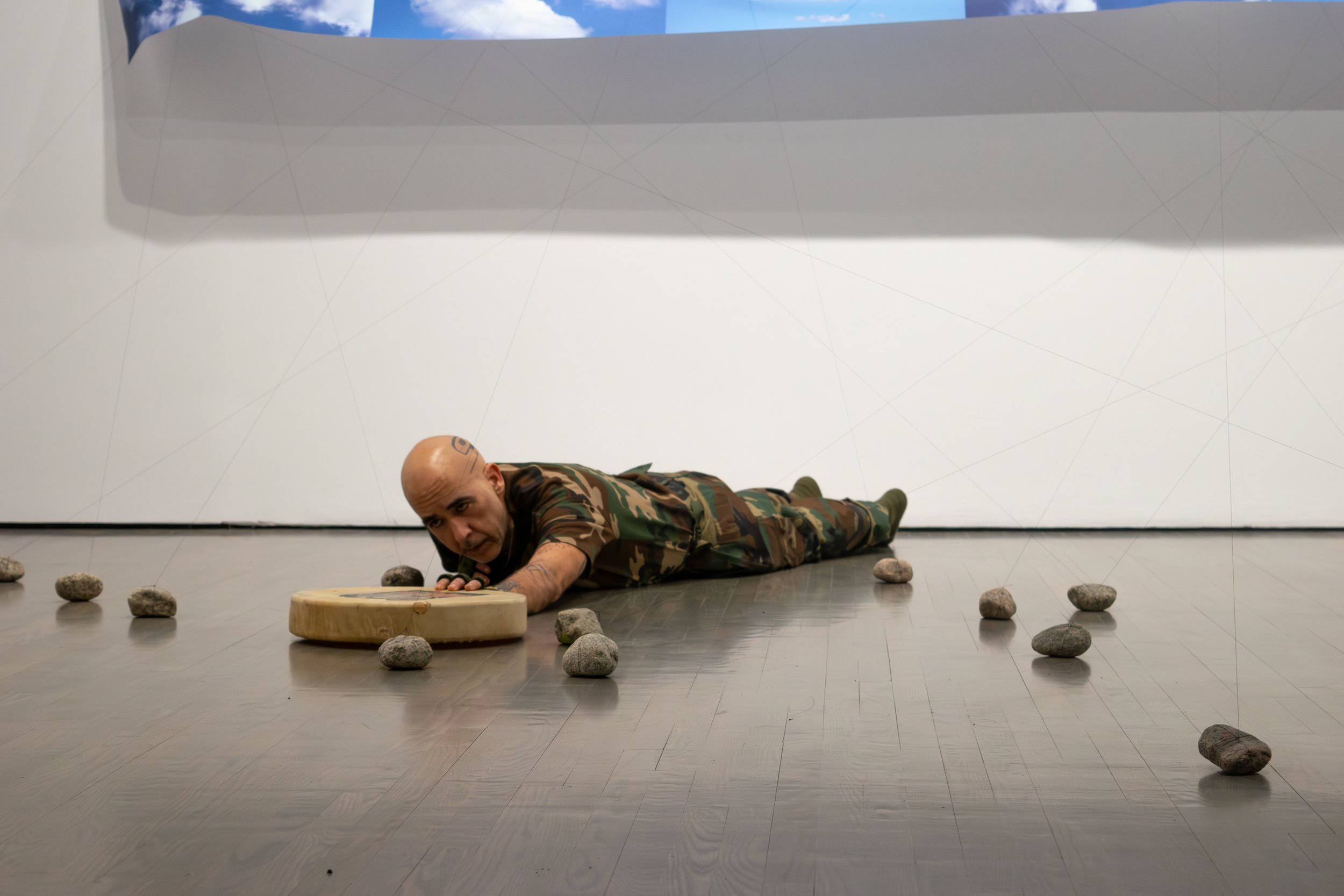
Figure 7: Peter Morin addressing skystrip by Hannah Claus. Photo credit: Pierina Corzo-Valero–Morin. Courtesy of the Leonard & Bina Ellen Art Gallery
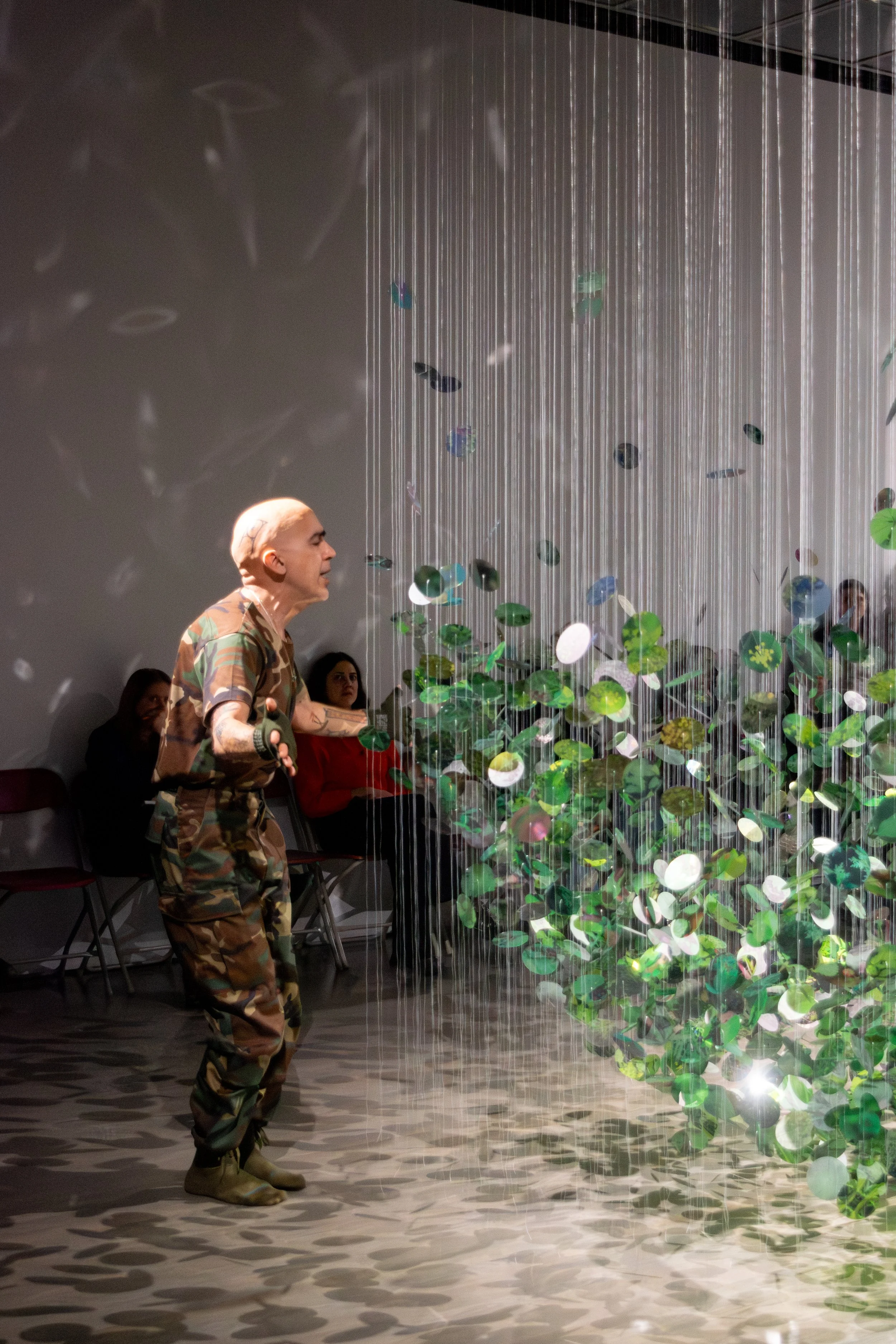
Figure 8: Peter Morin addressing dish by Hannah Claus. Photo credit: Pierina Corzo-Valero–Morin. Courtesy of the Leonard & Bina Ellen Art Gallery
Morin’s repertoire of bodily motions also includes crawling. Thus, in his address to watersong, he lies face down on the floor and propels himself around the curtain of threads by slowly, arduously stretching his forearms forward to form a pinion, and dragging his body along (Figure 6). His back is draped with the beaver skin. A rendition of All Along the Watchtower by Yul Anderson plays in the background. This spectacle is quite riveting. It puts one in mind of a wounded animal, its body mangled by some trap, painfully inching its way along the shoreline.
The beaver cloak betokens Morin becoming animal in solidarity with the countless beaver whose lives were wrested from them during the era of the Fur Trade – the first incursion of capitalist extractivism on the continent, which subsequently spread from the Eastern Woodlands to the Great Plains, leading to the near total extermination of the bison, and which now threatens the continued existence of the Pacific salmon on the West Coast. Being from out west himself (Morin grew up in Smithers, BC), Morin’s donning of the camouflage clothing is also familiar to him because of Indigenous Land Proctors in the North while the beaver skin expresses his acknowledgment and thanks to Claus, the Kanien’kehá:ka First Nation (including the Warrior Society for their defence of the Earth) and all of the relations named in the Thanksgiving Address.
The pattern of Morin’s breathing, like his mode of travelling, is also heavy: it has a rasping sound. This manifestation of his exertion, which borders on the superhuman, makes one feel drained, out of sympathy with his laboured breathing and heaving, heartwrenching mode of locomotion.
In his address to skystrip, Morin – crouching – begins at the outer edge of the stones, using the tanned deer skin to wipe the floor between the stones. But this gesture is not to clean or polish the floor, it is to mark it with the scent of the smoked tanned leather. He then takes his drum and – lying prone – goes in behind the stones and rubs the drum (with its raw hide covering) between the rocks in the opposite direction (i.e. outward instead of inward). The rubbing action (again) is not to vacuum up or wipe clean but rather to imprint the floor’s surface with the scent of deer, restoring it to earth, or ‘bringing the outside in’ (Figure 7). Finally, he takes an eagle feather and brushes the wall in behind the outstretched canvas.
In his address to reflection on river rock [Blue Nordic], Morin – kneeling on the floor – sings the words of a song his mother wrote during the 8th year of her Alzheimer’s journey. This is the first Tahltan song, written in over 90 years.
In his address to dish, he circles the giant bowl, imploringly raising his arms up above his head and down to his sides, up and down, while singing a song from the Cree Elder Joseph Naytowhow (Figure 8). This song was used with Naytowhow’s permission, as Morin made clear. This goes to another Indigenous legal principle – namely, always acknowledging and thanking one’s sources, both human and more-than-human. Songs are for sharing, not for owning. Reciprocity, not intellectual property (i.e. copyright) rules the relationships among Indigenous artists, a continuously expanding network (Garneau 2016). This understanding was evidenced in the aftermath of Morin’s intervention, when he and Claus reminisced about the many artistic projects they had collaborated on in the past 12+ years, such as there are so many stars at Oboro Gallery, Montréal in 2017.
Unlike the ‘star-maker machinery’ geared to propelling recording artists up the pop charts of which Joni Mitchell sings in Free Man in Paris, the Claus-Morin collaboration there are so many stars was an exercise in mutual upholding and remembering. Claus-Morin made new work that honoured the significant Indigenous artists who inspired them and inspired them to dream. Indigenous performance and installation art is all about acknowledging and giving thanks. Morin’s ‘Performance for Hannah’ is a case in point. It is ‘relational art’ (Bourriaud 2002) with a First Nations’ inflection.
Acknowledgments
Writing this review essay was motivated by my involvement in the ‘Sensitive Material’ research project, generously funded by the Social Sciences and Humanities Research Council of Canada (grant no. 430-2024-01324). I wish to thank Hannah Claus for the inspiration I derived from her exhibition, and Peter Morin for taking time to talk with me about his intervention. I also wish to thank Prakash Krishnan, Coordinator, Public Programs and Education at the Leonard & Bina Ellen Art Gallery for facilitating my access to the exhibition and reproduction/representation of materials and events
References
Bourriaud, N. 2002. Relational Aesthetics. Cambridge: MIT Press.
Broglio, R. 2008. Technologies of the Picturesque: British Art, Poetry and Instruments, 1750-1830. Lewisburg: Bucknell University Press.
Burisch, Nicole. 2025. Between ground and Sky. tsi iotnekahtentiónhatie (Tiohtià:ke) – [where the waters flow] (Tiohtià:ke). Montréal: Leonard & Bina Ellen Art Gallery.
Classen, C. 2017. The Museum of the Senses: Experiencing Art and Collections. London and New York: Bloomsbury Academic.
de Bruin, T. 201s. Kanesatake Resistance (Oka Crisis). The Canadian Encyclopedia, https://thecanadianencyclopedia.ca/en/article/oka-crisis
Hetherington. K. 2025, The time of ghost rivers. Environmental Humanities 17(3): 657-675 https://doi.org/10.1215/22011919-11956653
Garneau, D. 2016. Imaginary spaces of conciliation and reconciliation: Art, curation, and healing.” In D. Robinson and K. Martin (eds.) Arts of Engagement: Taking Aesthetic Action In and Beyond the Truth and Reconciliation Commission of Canada. (Waterloo: Wilfrid Laurier University Press, 2016
Glover, F. 2020. A dish with one spoon. The Canadian Encyclopedia, https://thecanadianencyclopedia.ca/en/article/a-dish-with-one-spoon
Howes, D. 2022. The Sensory Studies Manifesto: Tracking the Sensorial Revolution in the Arts and Human Sciences. Toronto: University of Toronto Press
Howes, D. and Salter, C. 2019. “The performance of sensation: Dramaturgies, technologies and ethnographies in the design and evaluation of performative sensory environments.” In M. Borowski, M. Chaberski and M. Sugiera (eds.) Emerging Affinities: Possible Futures of Performative Arts, 127-48. Bielefeld, Germany: Transcript Publishing House.