
Catalogue of Practices of Production, Animation, and Socialization of Artifacts
Urban Indigenous People Sensing Belonging Through Wâhkôhtowin
by Holly Aubichon
I am 18 years old, driving home from the south end of Regina in my 2004 Ford Taurus on the coldest night in February 2017. With windchill, it is -52 degrees Celsius. Suddenly, the steering wheel jolts to the left and then the right. I grip the wheel. It continues to shake. I pull into a residential road. I feel panic rise. I get out of the car in my moccasins and thin ankle socks. I try closing the driver’s door, but the latch is frozen open. My left front tire is flat and half off its rim. I have no one to call. My boyfriend is heading to work; my dad, Marty, is asleep; Susan, my mum, is in a different town. Both my car and I are losing heat.
As I gather my personal belongings from the centre console, I notice flashing lights: a taxi. The driver tells me he saw what happened, do I need a ride? I can’t afford it but with no time to think, I jump in. As we drive across the city, I text my close friend, Morgan, to tell her what is happening. I arrive to find Morgan at my house. She drives us back to my car to meet up with her dad Dean. I am so relieved, I cry. Her dad, bundled up for the cold, tools in hand, places cardboard down by the wheel and replaces the flat with my spare tire. He repaired everything he could, and I am able to drive home.
I remember the night vividly. Frostbite tingling the exposed skin on my ankles and ears. I was stranded. Even once I was picked up, I worried my car—with the door frozen open—would be totaled. I worried that I couldn’t pay the tow and service charges. My parents rarely came to my rescue. I didn’t call them because I knew they would tell me to figure it out for myself. I imagined them saying: “hard things in life happen,” or “you need to be more prepared.” My dad told me that when he was young there was no one to rescue him and his dad did not put up with begging. I learned early on that my parents' childhood experiences limited what I could expect of them. This was the same situation for the Indigenous friends I grew up with.
My grandpa, Martin, cared deeply about his northern Métis lifestyle in Green Lake, SK. He hoped to raise his family within his culture. He and his wife had eight children. The first five were girls, followed by my dad, Marty, and his younger brother, Chuck (Chuck had a twin, Donald, who died when he was just over a year old). To keep the remaining family members together, my grandparents felt they had to move the family to Regina in 1964. My dad’s Cree mother, Nelda, died when he was two years old. My dad has no memories of her. His oldest sister, Sandy, took care of him. She died at twenty. My dad was ten. My grandpa was suffering after Sandy’s death and was selfish as a parent. My dad doesn’t remember his dad being around much. My dad recalls that my grandpa was often traveling to his Green Lake or Meadow Lake, organizing with other Métis men[1], racing horses, and gambling. During my dad’s teen years, he was responsible for his siblings, Chuck and Wege. His remaining older siblings were gone between Regina and Vancouver for years, following their addiction to East Hastings. Everyone in his family, except for my dad, had addictions.
For my friend Morgan and her dad, asking for help was enough and both of them would act without hesitation. It hurt me that I didn’t have that kind of healthy family dynamic with my own dad. I had been accustomed to not only not ask for help, but to assume that it would not be available even if I did ask. My instinct was to comfort myself, protecting my dad’s experiences with a romanticized analysis of his choices: that the difference between Morgan’s dad and mine was cultural—that my dad was modeling an Indigenous way of teaching, knowing by doing, for my survival. I told myself that my family’s hardness was how I was meant to learn resilience. Thinking this way helped me stay sensitive to my dad’s traumatic upbringing. My dad’s understanding of being family was shaped by survival. Having long black hair and brown skin in the city, he grew up needing to be fearful of strangers' intentions and be ready to fight. His sisters were known to be great fighters too. This was their reality of growing up visibly Indigenous in the city, where racism is rampant and violence follows. Their experiences were isolating and conditioned them as young children to feel that struggling alone was the brave thing to do.
Still, I’ve come to realize that not being there for your children is not a way of being or teaching; it’s a form of neglect. It was challenging to separate neglect from my experiences of kinship, needing to return to stories of love—moments when friends and their families have cared for me as their own. I want to be close to my family, I want to learn and love in the traditional way, with blood kin. Forced assimilation, generational disfunction, trauma make this path complicated and personal.
The Cree/ Métis idea of kin, Wâhkôhtowin, describes our relations beyond family. Wâhkôhtowin is more than a feeling of kinship. It is a set of articulable social contracts that guide the behaviours of a specific group who both support and hold each other accountable. Maria Campbell, a Métis Elder from Saskatchewan remembers how she was taught and shares how to be in relation with each other, defining wahkootowin.
…And our teachings tell us that all of creation is related and interconnected to all things within it and wahkootowin means honoring and respecting those relationships. There are stories, songs, ceremonies, and dances that taught us from birth to death, over and over again our responsibilities and reciprocal obligations to each other. Human to human, human to plants, to animals, to the water and especially to the earth. Our whole environment, our world in turn also had responsibilities and reciprocal obligations to us[2].
Being kin and understanding Wâhkôhtowin requires an individual to choose to maintain good relationships with each other. Healthy kin have an understanding to act with reciprocity towards each other — the principle of miyo-wicehtowin, or good relations. Campbell references both the city and rural communities living with many broken understandings of Wâhkôhtowin and that the teachings once taught to children are no longer taught. However, she tells the reader there is healing we can do. She writes, “rather than focusing on what the outside world is doing to us, we need to think about what we are doing to each other”[3]. She is asking us to shift our focus, take time to learn to become kin again through being together to share stories, songs, ceremonies, and dances.
Before I knew Wâhkôhtowin, I imagined my ability to be in relation to the world around me, the earth and water, animals, the stars[4].
My final semester of high school was in 2016. I joined an outdoor-ed class that canoed for five days on the Churchill River in Northern Saskatchewan, a route 260km west from my dad’s homeland, Green Lake. When we settled camp on our first day, I offered tobacco to the water to introduce myself. I was excited to connect to my ancestors’ territory with a sacred medicine that connects us with the spirit world.
The next day, everyone was given a compass and map, and we took turns navigating. We navigated our way East, starting at Missinipe through to Stanley Mission and landing at our destination, La Ronge. We had four portages over small islands, we maneuvered around waterfalls, and heavy currents. Our decisions amounted to whether it was better to take a right or left around an island, which way would be too shallow or rocky, longer or shorter than it appeared, had a place to land for a break or not, and so on. When a classmate called out a way that the tour guide knew would be more challenging, or take us further from our goal, our guide would take charge by canoeing to the front and explain the correct route and why. He never came to the front to explain a better choice for the class when I was navigating.
I thought to test my intuition. I stopped looking at my map. I imagined, just maybe, I had come across ancestral tracks that would guide me. I felt a shared relation to this environment, as if this were a predestined waypoint for me. Like the spirit of my relations were excited to show me the way around their home for the first time.
At the final campsite, I was the first to reach the shore. The canoe’s hull scraped the pebbles, and the smell of wet earth and pine filled the air as we beached. My canoe partner and I wanted to land first so we could use the bush bathroom before the others arrived. As I walked inland searching for the perfect spot to dig my hole, I saw an eagle feather resting on the dirt. Eagle feathers are sacred. They are usually given through ceremony by an Elder to honour a person’s deepening relationship with the natural and spiritual world. Yet here it was, waiting for me, as though placed with intention. I didn’t pick it up. At the beginning of the trip we were told that no one was permitted to take anything home. I abided by settler rules.
When I returned home and shared stories about following some kind of spirit tracks and finding that feather, I was told that sometimes an animal offers a gift directly—when it chooses to, and when you are ready to receive it. I realized then how much knowledge surrounds us. From generations of listening, observing, and living in reciprocity with the land and all our relations, my ancestors have prepared teachings to be found everywhere.
That experience changed how I moved through the world. I often need to break, bend, or bypass settler rules when they are in conflict with Indigenous ways of knowing, being, and doing. I began to sense similar threads of connection in nature that I had felt canoeing on the Churchill River. In the past I saw the city as the city and nature as outside it.
Before the trip, I would complain about walking to school in the cold winter and decide to stay inside all weekend. Now I recognize these moments as daily rituals of choice. To see and listen to my relations’ wherever I am and be ready to pick up the feather. I walk more often, let my feet meet the ground with attention. An impulse to climb trees again, and crawl into the bushes along Wascana Lake where, as a child, we built our secret homes. It feels instinctive to greet the rabbits and geese lingering in similar places, to talk to them as though they were my old friends. The boundary between the city and the bush diminish.
Spending more time outdoors also brought me closer to my dad[5]. Our time together is usually on his terms and at his pace. My quiet walks quickly turned into faster-paced adventures. He preferred us to zoom down dirt paths on our bikes. We both love the feeling of flying downhill—the laughter, the blur of trees, the shared joy of being outside and in motion. Those moments remind me how connections are not only found when out on the land; it’s something that grows in the city between people as well. The first time I saw my dad bike downhill, he swung his left foot back and over the seat, crossed his swinging foot over to his right and stood tall. He glided downhill– appearing to have slowed time. He looked back at me, making sure I copied him. I did. As I start to feel time slow down, I look around me and see two prairie dogs, a parent and its child following behind, gracefully leaping in unison. I laughed. Did my dad and I just synchronize with the prairie dogs? It even looked like they stopped and stared back. My dad, who was ahead of me, slowed down to my pace, and turned back to me to say “did you see that?” The grins on our faces grew wider, and we burst into laughter. We both imagined a narrative of ourselves having the same spirit as those two prairie dogs. Before that encounter, my dad would be biking far ahead of me, often where I could not see him. Now when we bike, we’re close together. With the sun and wind on my skin, I feel the most activated to imagine myself and my dad as our ancestors on their horses and thinking about what they saw or what got them to look, similarly to my dad and our bikes.
Dwayne Donald is a Cree Education professor from Amiskwaciwaskahikan (Edmonton) who uses walking and imagination as a creative research tool to build a relational practice. He wants to be recognized as a relative when on his ancestor’s land. In We Need a New Story:Walking with Wâhkôhtowin Imagination[6]. Donald describes how, while walking through familial territory, he uses his imagination to think about the action of being in relation to the kin that is present there. He was told stories teaching about places as living relatives, and that they offer wisdom on how to live a good life. He had prepared himself through those stories he was told, then gathered his medicines’ and made his personal pilgrimage to the Viking Ribstones, 151 km from Edmonton. This is an ancient sacred site dedicated to the spirit of the buffalo and in honour of their provisions for Indigenous people, located on top of a prominent hill. This hill has ancient stone carved buffalo bones. These stones were carved by Plains people over a thousand years ago. Walking on that hill to be with the stones as a kinship practice led Donald to perceive life around him differently.
Contemplating on what he saw and felt, in addition to his cultural knowledge and his imagination about his kin, evolved into a unified story. He recognized how walking stimulated his sense of belonging to his surroundings. “Walking and the wâhkôhtowin imagination can help us re-story ourselves—individually and collectively’[7]. In movement, Wâhkôhtowin imagination is activated and he can think creatively. I think about how he moved between the stones, noticing the relationship the stones have to this place, his ancestors, and now himself returning there. He describes the physical barriers he crossed, private property and barb wire. He knew it was important. Donald begins his article We Need A New Story… reflecting on how stories told through Canadian schools perpetuate a damaging colonial legacy that results from relationship denial. He commits to walking as a life practice in continuity of his ancestors' practices and to take care of the potential of enabling relational renewal[8]. I believe by allowing his imagination to be a part of his practice of renewing kinship relationships and practicing Wâhkôhtowin, he brings the potential for these renewed relationships to hold teachings that relate to stories of the past, while having the potential to retrieve new teachings for our current times and challenges. Donald believes walking and the Wâhkôhtowin imagination can work towards the possibility of experiencing life in a way that his ancestors knew the world.
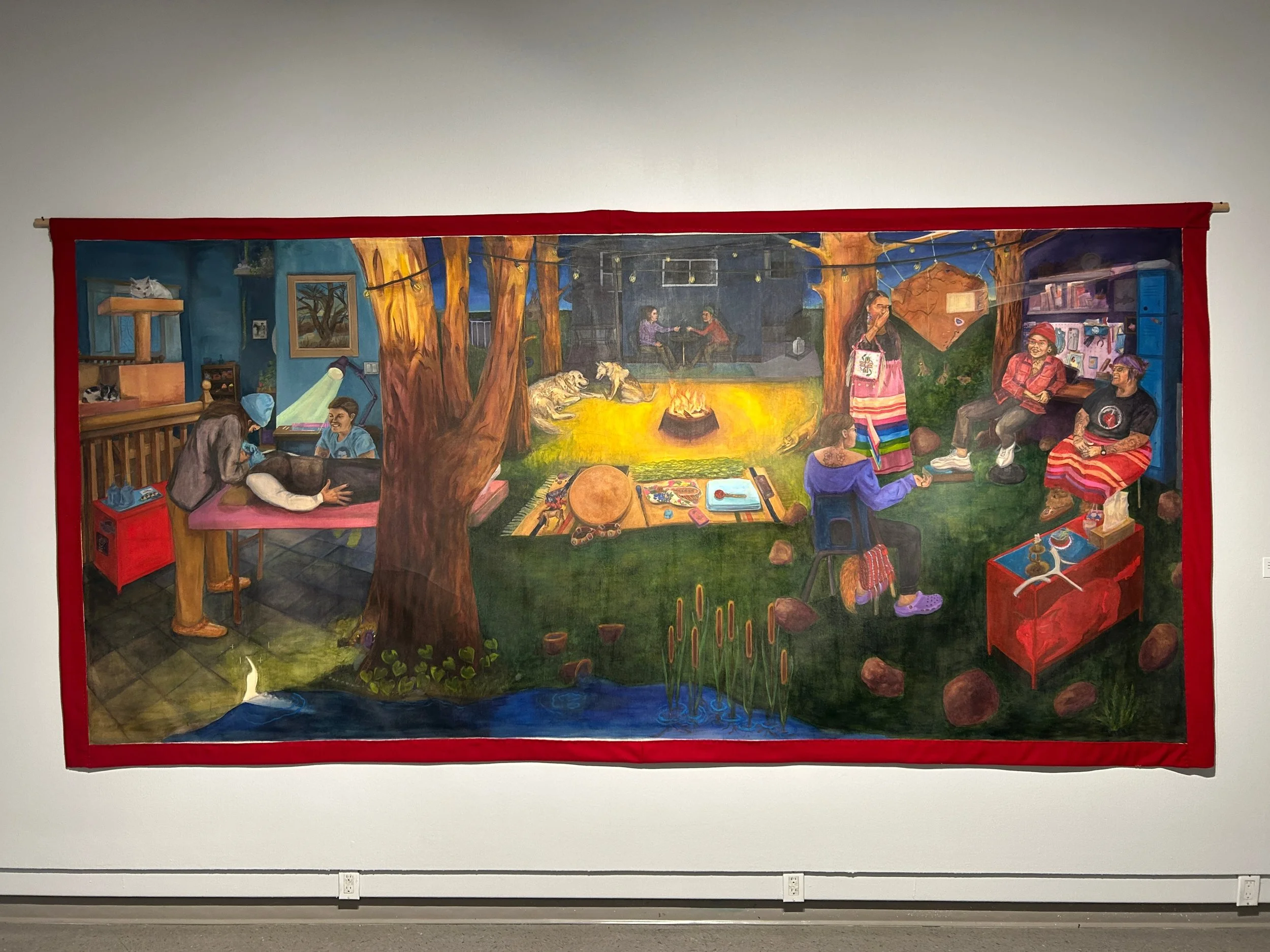
Donald continues to walk as a relational practice, offering river walks in his city, Amiskwaciwaskahikan, for others to join. He practices a Cree teaching model of learning by doing, to exemplify the possibility of sensing belonging and to be in good relation to the land and each other. I have learned by becoming kin that visit regularly, we will notice ways to take care of each other. To take care of each other is a value of Wâhkôhtowin. Using my imagination and intuition to interpret cultural stories told to me, my lived experiences, and reading Cree/Métis history records, I can test and practice kinship relationships and protocols for recovering my Indigenous relations that lie below and above the soil. I recently finished a painted reflecting on my experiences relating to Donald’s and Maria Campbell’s writing to contemplate and imagine what Wâhkôhtowin looks like in my life now.
Wâhkôhtowin (pictured below) is a twelve foot long by six foot tall painting. It shows three urban spaces where my chosen kin, and I conduct ceremonies. Each scene has trees, water, and plants. They are utopic spaces for relational living where my more-than-human kin are present and have agency. I animate light fixtures to represent ceremonial space and spiritual presence as a way to engage in teachings passed down through to urban spaces. On the right are the four members of my tattoo group; Stacey Fayant, Geanna Dunbar, Jayda Delorme and myself. We’re visiting. We are ringed by a circle of stones. In the foreground is a large red “medicine” cabinet holding objects used to care for an individual receiving a tattoo from my mentor. On the far left is my dining room where I tattoo. These scenes mirror each other, to represent mentorship and ways I’ve applied what I have learned from our groups mentor, Stacey.
The middle scene shows a Hudson Bay blanket covered with cultural items on top. All are gifts given to me by folks I’ve tattooed. I do not take cash. I explain that traditional Cree would have exchanged horses for tattoos. Gifting a horse to someone meant that they could travel further to other communities, learn from others or exchange goods. I ask people to contemplate how they could support me. I don’t need a horse while living in the city. Gifts can include drums, rattles, knives, cloth, traditional medicines, even teachings. Behind the blanket of gifts is my dad's backyard fire pit. Behind it, he and I sit. Him and I sit distantly from the group of women I call chosen kin and the cultural revival. I depict the tension between my blood kin in my life this way, showing my blood kin what I am doing with my chosen kin, yet my blood kin are not yet actively taking part in what we are doing. I I believe that my connection to my blood relatives are still vital for recovering cultural knowledge, sustaining kinship, and understanding relational responsibilities. I have learned that striving to be a good relation with those I call chosen kin has shaped how I can relate to my dad and find mutual ways to restore Wâhkôhtowin between and beyond the two of us.
In the foreground is a pond, a tree, and plants[9] where Indigenous spirits are invited in. There is a deer jawbone pushed onto the shore from the water, with symbols of Cree stars floating above. It represents a tattoo that my friend had a dream about, where she saw herself with a Cree chin tattoo, including an outline of a deer jawbone. She is depicted on the left receiving the dreamed tattoo. The three narrative spaces transition between each other using natural space (Trees, water, plants) include elements beyond my human kin relationships occupying these spaces, to make visible my relations and imagine new stories and presence to the painted spaces.
The painting is framed with red Melton wool, stitched to the canvas like the edges of a quilted blanket[10]. I can roll it. It is not a wall painting but a traveling teaching tool. I want to bring the painting when I visit people in community spaces, to share stories about Wâhkôhtowin values from my urban Indigenous experience, and when possible, alongside my painted kin. I want to practice a similar function that Plains hide paintings have been used, such as painted buffalo robes, winter counts, and tipi liners[11]. These objects are devices that Indigenous people use to document their community's history, lessons and experiences. They functioned as teaching tools, verified by their community to archive and recall their history and teachings. They are activated by orally sharing the stories represented as a way to hand down information between generations. My painting Wâhkôhtowin visualizes what my chosen kin and I have learned, and who we are. Through it, we can talk about our experiences as urban Indigenous women. It records what we know and hope to someday understand.
My painting highlights my lessons learned, joined with my chosen kinship bonds at this point of my life, as a twenty-seven-year-old Indigenous woman. I am grateful for the Indigenous women represented in my painting; they have shown me love that feels constant, offering me the support so that I can return what I learn from my chosen kin to my blood kin. I feel safe knowing that they will go place medicine down for me after I talk to them about hardships going on in my life. Through chosen kinship, imagination, and the teachings of Wâhkôhtowin, my painting shows what recovering and sustaining kinship look like in modern urban times.
Wâhkôhtowin by Holly Aubichon
Endnotes
[1] My grandpa, Martin Aubichon, took on random jobs and community projects to support his Métis community with employment, access to food, through community garden initiatives and worked as a social worker once his children were adults.
[2] Maria Campbell, “Eagle Feather News,” Human Rights Conference November 1, 2007 (Saskatoon, 2007), 2.
[3] Ibid, 4.
[4] I had stories from hanging out with other Indigenous kids, my Indigenous relatives' and their behaviours towards these elements of our world. As a teenager I had opportunities to sit and listen to strong women in leadership and elders while being on the Newo Yotina Friendship Center youth council from 2010-2016. This instilled the belief that I could be related to things other than my family but not yet what that looked like.
[5] I’ve always known him as someone who moves easily among animals—making friends with squirrels, crows, rabbits, prairie dogs, pelicans, and geese, not to mention his house full of dogs and cats.
[6] Dwayne Donald, We Need a New Story: Walking with Wahkohtowin Imagination (Journal of the Canadian Association for Curriculum Studies, 2021).
[7] Dwayne Donald, We Need a New Story: Walking with Wahkohtowin Imagination (Journal of the Canadian Association for Curriculum Studies, 2021), 62.
[8] Ibid, 55.
[9] The plants represented have been tattooed on myself and others.
[10] I saw Joseph Sanchez frame one of his paintings with red felt and at once felt the effect of the blanket frame as relating to Indigenous practices of gifting blankets. I finished my work similarly. I thought about how his painting may be representing a gift. He was in Banff while I was at the Banff Centre for the Arts, and I got to spend time with him, and share the effect the fabric frame had on me.
[11] Jordan Dresser, “Stories Unbound: Exhibition of Narrative Art Shows More than a Century of Native Life on the Plains,” American Indian Magazine, 2024, https://www.americanindianmagazine.org/story/Unbound-Exhibition-narrative-art-Plains.
Works Cited
Campbell, Maria. “Eagle Feather News.” Human Rights Conference November 1, 2007. Saskatoon, 2007.
Donald, Dwayne. 2021. “We Need a New Story: Walking and the wâhkôhtowin Imagination”. Journal of the Canadian Association for Curriculum Studies 18 (2):53-63. https://doi.org/10.25071/1916-4467.40492.
Dresser, Jordan. “Stories Unbound: Exhibition of Narrative Art Shows More than a Century of Native Life on the Plains.” American Indian Magazine, 2024. https://www.americanindianmagazine.org/story/Unbound-Exhibition-narrative-art-Plains.