
People
-
Anthropologist of religions and museums Co-investigator (Co-I) Sowparnika Balaswaminathan is Assistant Professor in Religions and Cultures at Concordia University. She researches the politics of art and craft, artisanal identity and labor, and the intersection of ethics and aesthetics in the postcolonial Indian context. Her methods include ethnography, arts analysis, and archival research. Forr this project, she will build on her on-going research into the permeable boundaries between persons and things by conducting archival and ethnographic research on the contemporary repatriation politics around Hindu idols in India. Focusing on the chimeral nature of the South Indian bronze idol, Balaswaminathan has explored the evolution of the religious artifact into an art object celebrated in museum settings and a commodified handicraft sold to tourists in previous research. In this particular module, she will track how religious idols from Tamilnadu enter the black market of illegal antiquities trade when they are stolen from temples, and the investigative and activist institutions involved in their retrieval. Combining media analysis, ethnography, and archival research, Balaswaminathan will conduct her research in three settings: in the pilgrimage town of Swamimalai where a community of idol makers live and have been accused of colluding with smugglers; in governmental institutions responsible for the safekeeping of religious artifacts, namely, the Hindu Religious and Charitable Endowment Board which supervises Hindu temples in Tamilnadu and the Idol Wing of the Economic Crimes Division of the Tamilnadu Police Department, which undertakes cases involving idol theft an smuggling; and grassroots activist organizations that investigate collections of museums and auctions houses to find smuggled religious objects. Balaswaminathan will consider how the religious bronze which is worshipped as a god is transformed into a moral test for sculptors, a ward of the state by governmental institutions, and a belonging in need of protection by the activists. While replete with material and bureaucratic processes, the sensorial engagement between these actors and the religious idols is transformative in that it recasts a god into being a dependant.
-
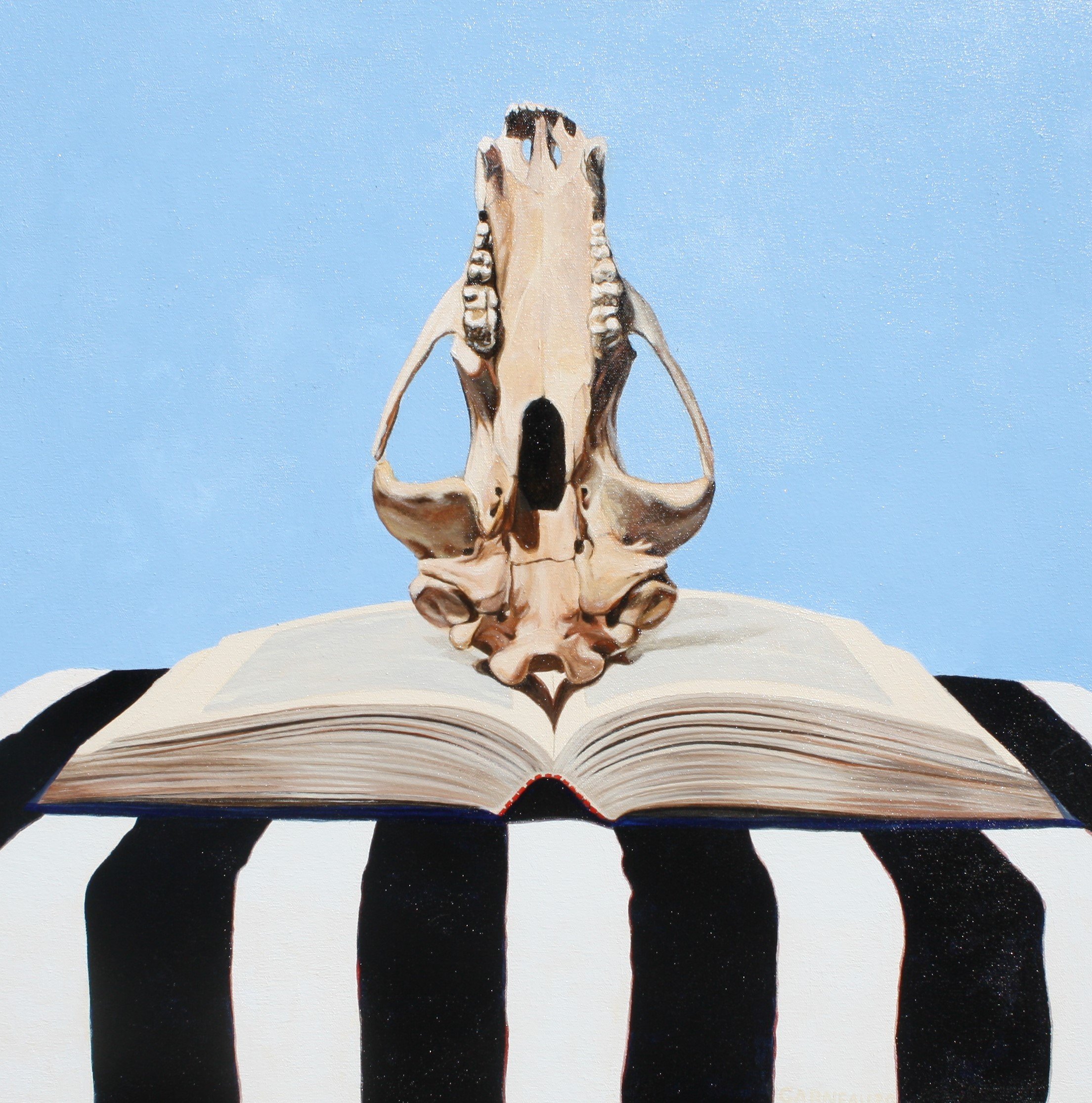
Métis scholar, curator, and visual artist Co-I David Garneau is Professor of Visual Arts at the University of Regina. He is a painter, curator and critical art writer who engages with creative expressions of Indigenous contemporary ways of being. An exhibition of 100 of Garneau’s recent still life paintings, ‘Dark Chapters’, curated by Arin Fay, is currently touring Canada, accompanied by the catalogue Dark Chapters (University of Regina Press, 2025). In 2023, Garneau was awarded the Governor General’s Award in Visual and Media Art: Outstanding Achievement, and inducted into the Royal Society of Canada. In 2025, he was invested into the Order of Gabriel Dumont – Silver. For this project, Garneau will undertake an ethnography of the production and animation techniques of Plains Indigenous Peoples; how Elders, Knowledge Carriers, creative makers, curators, and others, perform the ontology of things as kin. Of particular interest is how Blackfoot, Métis, Nêhiyawak, and other Indigenous folks recognize the relative aliveness and kinship of various handmade and found objects, and how these recognitions affect the making, use, care, sharing, and repatriation of these items. (WP 1.1). He will also review the innovative ways in which such artefacts are curated and displayed by Indigenous curators and non-Indigenous anthropologists in collaboration with Indigenous communities, as well as museal interventions by Indigenous artists, such as Tahltan contemporary artist Peter Morin, whose performance art involves a form of ‘sensory repatriation’ (Peraic 2023). In addition to written scholarship, Garneau is a visual artist whose paintings are a form of semiotic intellection. His metaphorical still life paintings—of rocks, stones, bones, books, chains, jars, water, smoke, plants, medicines, and other objects—picture Indigenous ways of knowing, being, and doing, but also explore conflicts and paradoxes in contemporary Indigenous experience. His paintings are a form of essaying/assaying that both reflects on what he learns from his kin and colleagues and generates some of the ideas he wrestles with them.
-
Principal Investigator David Howes is Distinguished Research Professor (Anthropology) at Concordia University and Adjunct Professor (Law) at McGill. In 2024, he was made a Fellow of the Royal Society of Canada, and in 2025 he was awarded the Doctor of Letters (DLitt) degree by University of Oxford. Howes is a pioneer of the anthropology of the senses and has also made significant contributions to museum studies, and law and socio-legal studies. He has published 16 books and 11 thematic issues of journal to date, and directed numerous large-scale team research projects.
-
Collaborator Maureen Matthews had 20+ years experience as an investigative journalist prior to becoming Curator of Cultural Anthropology at the Manitoba Museum. She is currently Adjunct Professor of Anthropology at the University of Manitoba. Her awards are many (including 5 Canadian Association of Journalism awards). Her theoretical and curatorial work has a dual Anishinaabe and anthropological focus bringing together strands of Anishinaabe philosophical and metaphorical thinking with contemporary anthropological work on the nature of personhood and the animacy and agency of artefacts. Her most recent work has concentrated on the role of Indigenous objects in challenging the interpretive authority of museums and on the ways that relational obligations are imposed on museums by their Indigenous collections.
-
Collaborator Peter Morin is a Tahltan Nation artist and curator from Prince George, B.C. and Assistant Professor at the OCAD University in Toronto. In his artistic practice, Morin probes the ‘impact zones’ that occur when Indigenous practices collide with western-settler colonialism. In addition to his extensive exhibition history centring Tahltan epistemology, he has curated numerous exhibitions. In 2016, he received the Hnatyshyn Award for Outstanding Achievements by a Mid-Career Artist.
-
Collaborator Kanako Uzawa is an Ainu singer, dancer and rights activist who has held numerous visiting artist residencies, and is currently Assistant Professor for the Global Station for Indigenous Studies and Cultural Diversity at Hokkaido University and an Adjunct Researcher at the Museum of Cultural History at the University of Oslo in Norway. She founded Ainu Today – A Way to Be (https://ainutoday.com/). Kanako has collaborated with Co-Investigator Mark Watson over many years and across different projects, all leading up to their current joint endeavour, ‘Our Exchange’.
-
Co-Investigator Mark Watson is Associate Professor of Anthropology at Concordia University. His extensive connections with Ainu communities derive from long-term fieldwork starting in 2001 with urban Ainu migrants. This led to Watson’s first book on the social history of ‘Tokyo Ainu’ (Watson 2014) as well as his co-editorship of Beyond Ainu Studies (Hudson, lewallen, Watson 2014), the widely cited text rethinking the colonial past of Ainu research in light of decolonizing critique. Watson has partnered with Collaborator Kanako Uzawa over many years and across different projects, all leading up to their current joint endeavour, ‘Our Exchange’.
-
Erin Lynch is an interdisciplinary scholar and Senior Fellow at the Centre for Sensory Studies who works at the intersection of space, mediation, culture, and the senses. She was recently awarded a PhD in Social and Cultural Analysis from Concordia University. Her doctoral research explores how city-sanctioned mobile tourism apps impact users' experience of urban spaces and attractions. Erin used multi-sited sensory ethnography to investigate how these “extensions of the senses” mediate the dynamic site of the tour - where narratives about the city are conjured on a shifting stage - and consider what kinds of histories, meanings, and experiences are privileged by these emergent tourism practices.
Erin holds both a Bachelor of Social Science and a Masters degree in Criminology from the University of Ottawa, where she studied how popular imaginaries about geographies of crime take shape on film, and how the maps of meaning we layer over the world are constructed somewhere between the “real” and the “reel.”
As she continues to explore how our cultural understandings and experiences of space are mediated, Erin is currently co-authoring research on the sensory ambiance of the casino.
-
Bio to follow
-
Holly Aubichon (Métis/Cree) explores how ancestral knowledge reaches urban Indigenous people through memories, land, and personal experiences. Her practice includes painting, tattooing, writing and curation. Aubichon was born and raised in Regina, Saskatchewan. Her Indigenous relations come from Green Lake and Lestock, SK.
Aubichon was the Artistic/Administrative Director for Sâkêwêwak Artists’ Collective from 2021 to 2023. In 2024 she returned to the University of Regina to pursue her MFA in painting, supervised by David Garneau and Dr. Sherry Farrell Racette.
Website: https://www.aubichon.ca
-
Sara McCreary is a Red River Métis artist and graduate student in the Master of Fine Arts program at the University of Regina’s Faculty of Media, Art, and Performance. Her research-creation practice includes sewing, quilting, beadwork, embroidery and natural dyeing to revive and adapt Métis material culture to suit the evolving needs of contemporary Metis. Guided by Mishimyeuhoo, the Michif word for “fancy” or “to be well dressed,” she approaches making as a tactile relationship which begins with visiting and collaboration. Through wearable art and contemporary materials, she restores visibility to the “flower beadwork people” and reclaims what it means to live a Métis life.
-
Mario Michas is currently a licensing candidate at the École du Barreau and holds a Bachelor of Civil Law and a Juris Doctor from McGill University's Faculty of Law. He has held research assistantships in the areas of comparative law, legal history, private law, legal theory, and judicial methodology. He is interested in judicial institutions and their history, the history of comparative law, and in private law history.
-
Lexi Rubin is currently a second-year student in the transsystemic Bachelor of Civil Law/Juris Doctor program at McGill University’s Faculty of Law. She holds a bachelor’s degree in criminology from Carleton University. She has worked in the areas of restorative justice, diversion, and access to legal information, including as a caseworker with the Collaborative Justice Program and as a legal information student at the Native Women’s Shelter. Her case stories, written for the Collaborative Justice Program, have been published in a Pearson Canada criminal justice textbook. She is interested in criminal law, restorative justice, and access to justice for vulnerable populations.